Explore
Try our research yourself. Play with demos built from our papers and student projects, explore curiosities about how music and hearing work, and download the datasets and code we release.
Demos
Our papers and student projects, as apps you can use in the browser.
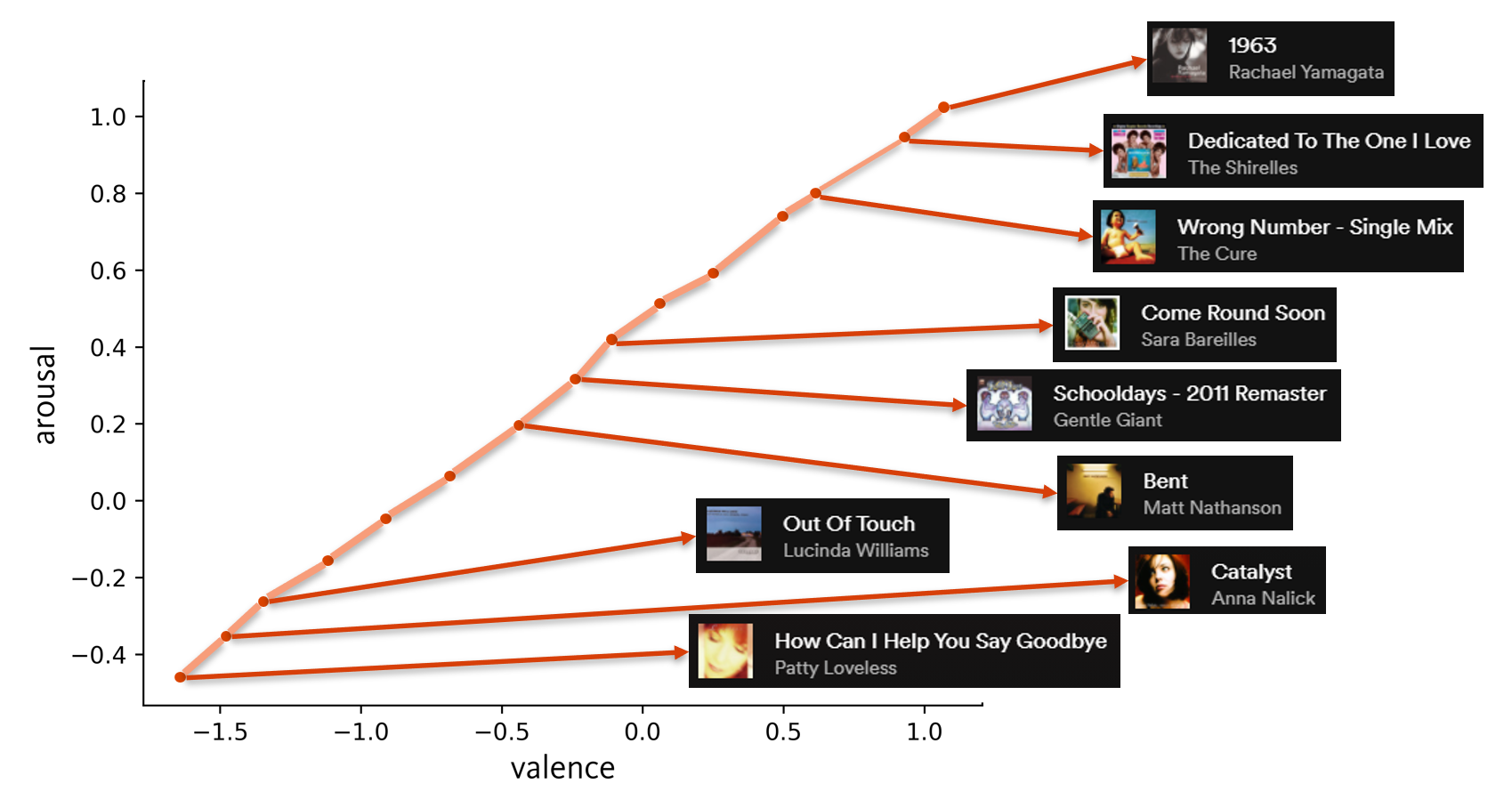
Mood Playlist
Build a playlist that moves smoothly from one song's mood to another's, one step at a time, plotted on the valence–arousal map.
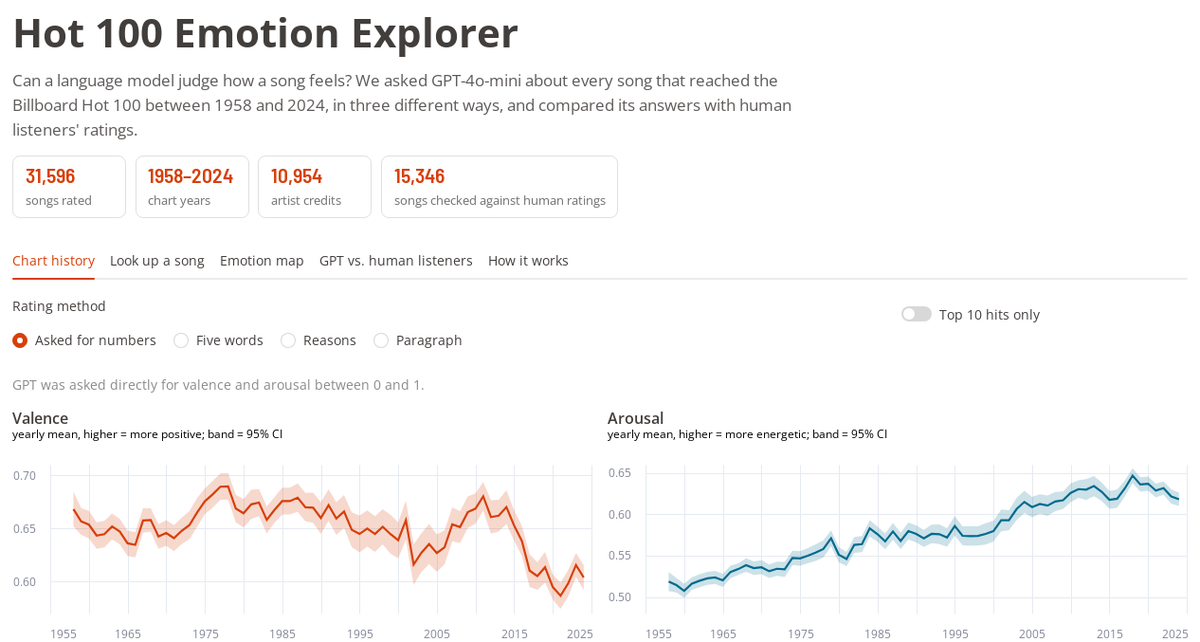
Hot 100 Emotion
See how GPT-4o-mini rated the mood of 31,596 Billboard Hot 100 songs (1958–2024), and how its ratings compare with human listeners'.
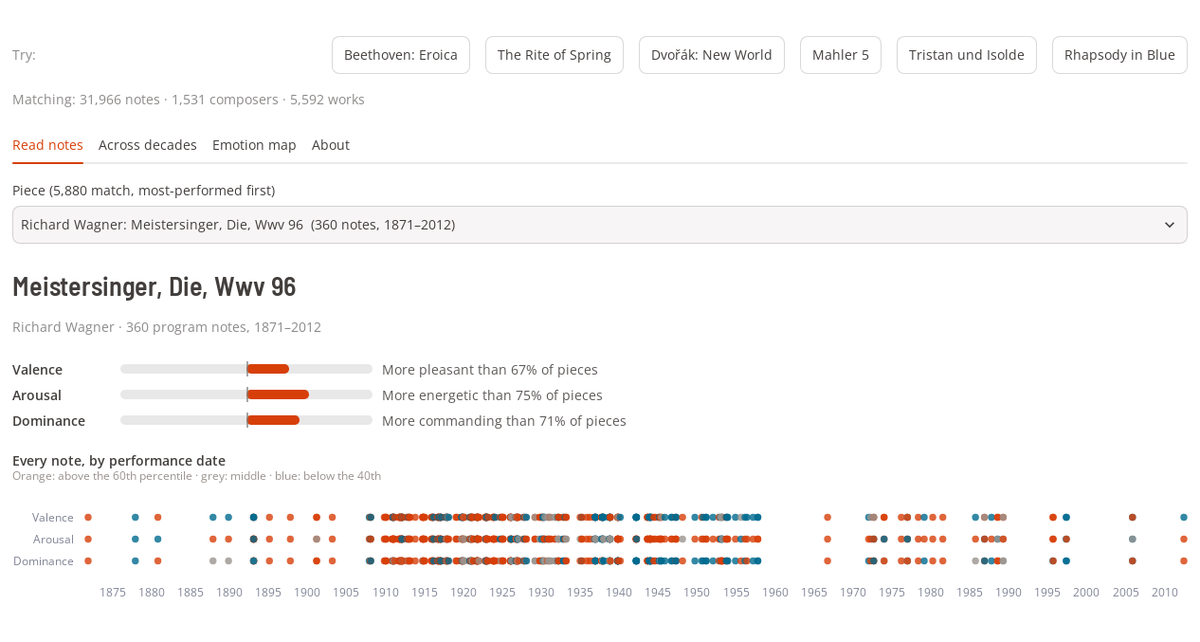
EmotioNotes
Search 32,000 New York Philharmonic program notes (1842–2023) by composer or piece, and see the emotion scores of each note.
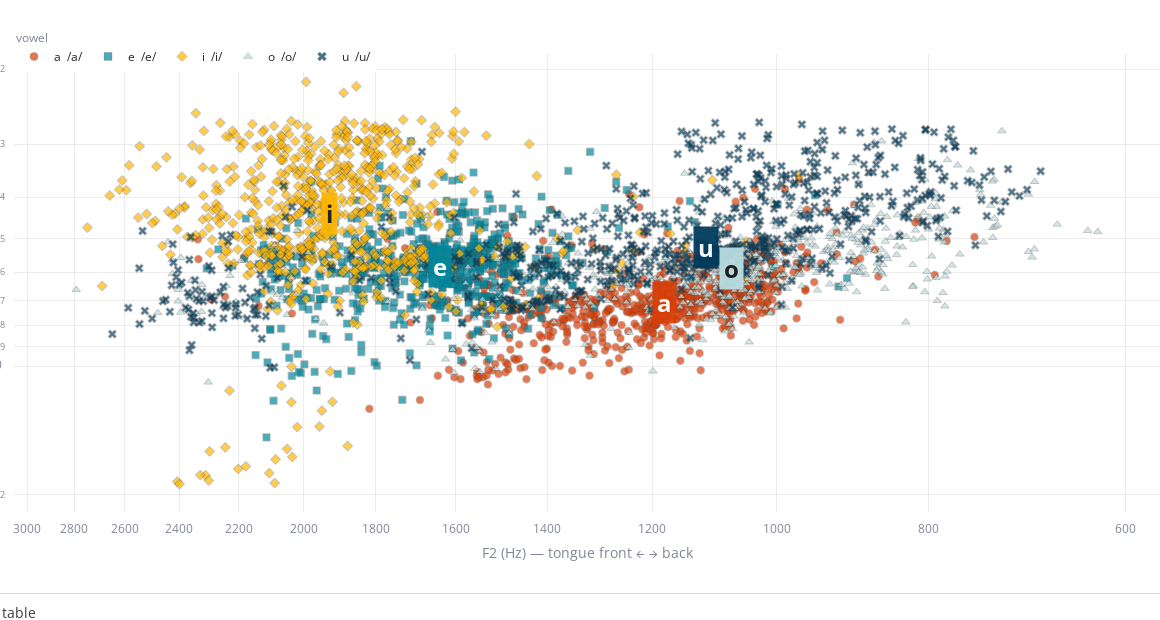
Sung Vowel Explorer
See how sung vowels blur at high pitch, hear where a classifier goes wrong, and sing into your mic to see which vowel it hears.
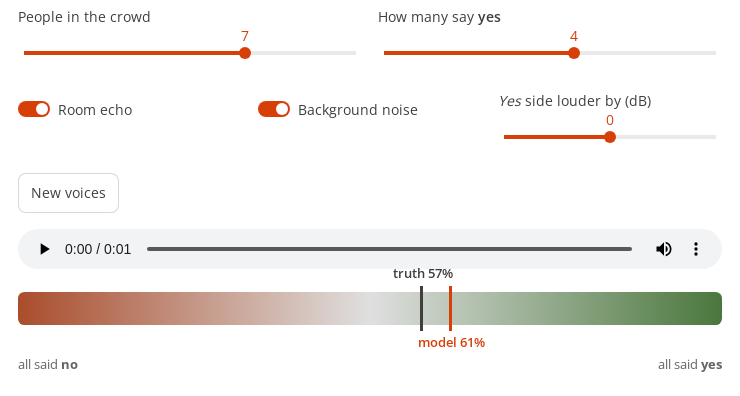
Voice Vote
Mix single yes and no voices into a crowd, see whether a model can hear how the crowd voted, and add your own voice to the mix.
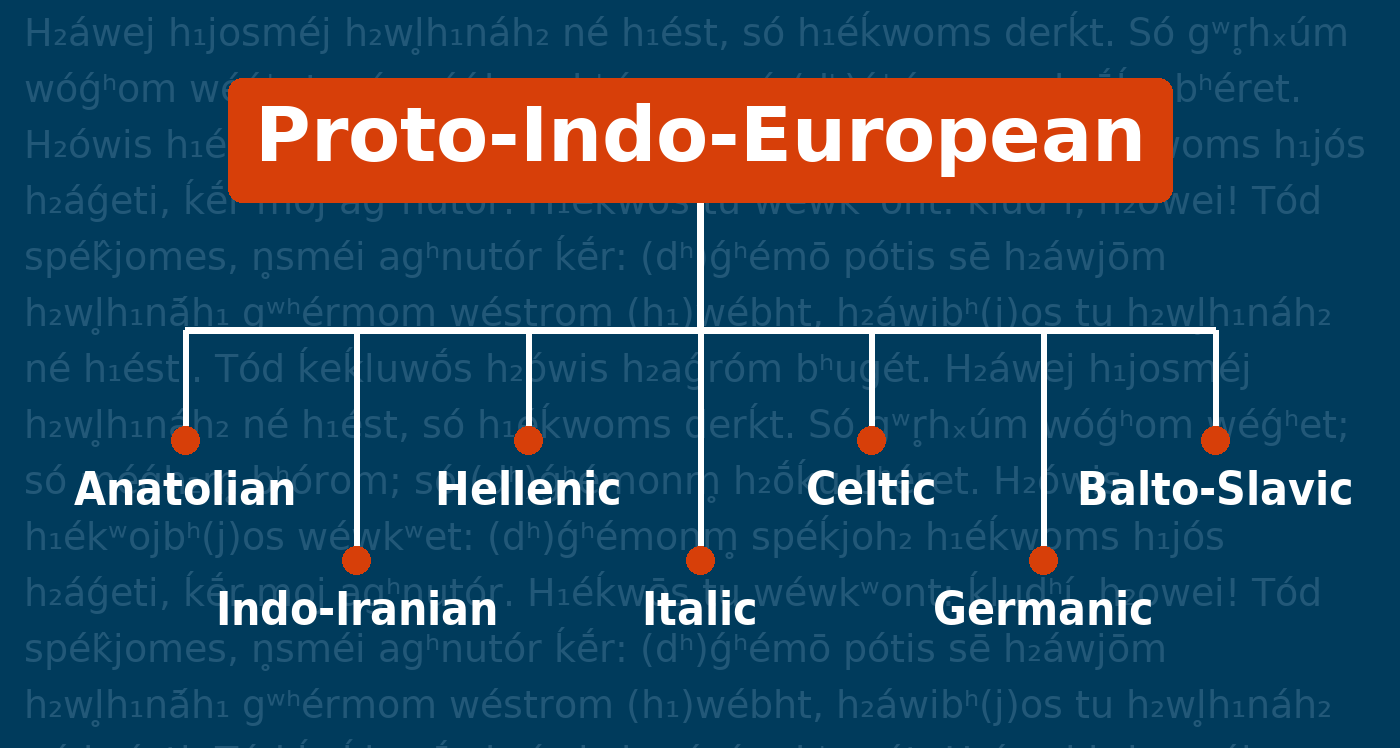
PIE Text-to-Speech
Hear hypothesized pronunciations of Proto-Indo-European words and fables, choosing the sound for each disputed phoneme.
Curiosities
Questions about music and hearing we couldn't leave alone.
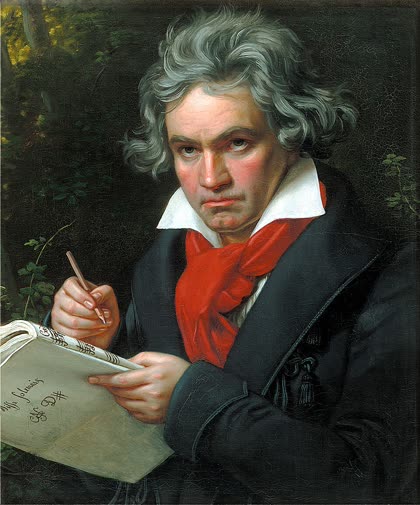
How did Beethoven hear his own music?
Hear his music as his failing ears may have delivered it, from the first signs of deafness in 1801 to the Ninth Symphony in 1824. Then try his hearing loss on any sound.
Listen Portrait: Joseph Karl Stieler, 1820What color is a C major chord?
Some composers saw colors when they heard music, and their lists don't agree. Watch a recording in Scriabin's colors, then in Rimsky-Korsakov's.
See it Colors: Scriabin's keys around the circle of fifths (Sabaneyev 1911)
What is a sound made of?
Every sound is a stack of sine waves. Add pure tones one at a time and hear a buzz, a bell or an organ take shape.
Build a sound Picture: a sawtooth wave's first six harmonics
Can a sound keep rising forever?
These sounds were built to break the rules of pitch. Decide what you hear, see how the trick works, then try to break it.
Listen Picture: a Shepard scale
Which notes belong together?
Two scrambled scales that turn into smooth melodies, a rhythm that splits in two, a tone that carries on through a burst of noise, and speech that turns into song.
Coming soon Picture: Deutsch's scale illusionDatasets
Data we've built and released for other researchers to use.
EmotioNotes
Historical New York Philharmonic concert program notes from the 1840s on, with performance metadata and estimated valence, arousal and dominance scores, for music emotion recognition and cultural musicology.
- Contents
- about 32,000 program notes, 1842–2023
- Labels
- valence, arousal, dominance (estimated)
- Host
- GitHub
SynTheory+
Synthetic 4-second audio examples, generated from MIDI, of polyrhythms, dynamics, seventh chords, mode mixture and secondary dominants, for probing what generative music models such as MusicGen and Jukebox encode about music theory.
- Concepts
- 5 music-theory concepts
- Format
- WAV
- License
- MIT
- Host
- Hugging Face