Student Projects
2026
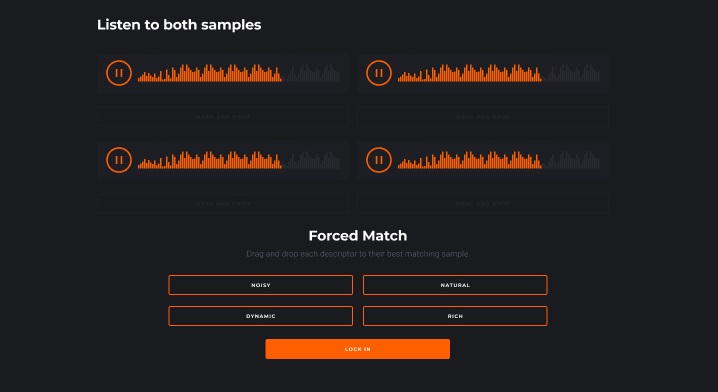
AURA: Audio Understanding and Research Annotation
Read more
AURA (Audio Understanding and Research Annotation) is a web tool for crowdsourcing labels for audio datasets. Participants play sounds and label them in eight modes, from Best Match to a two-dimensional emotion grid and labels over time; researchers manage studies, upload audio, build label sets, view analytics and download data.
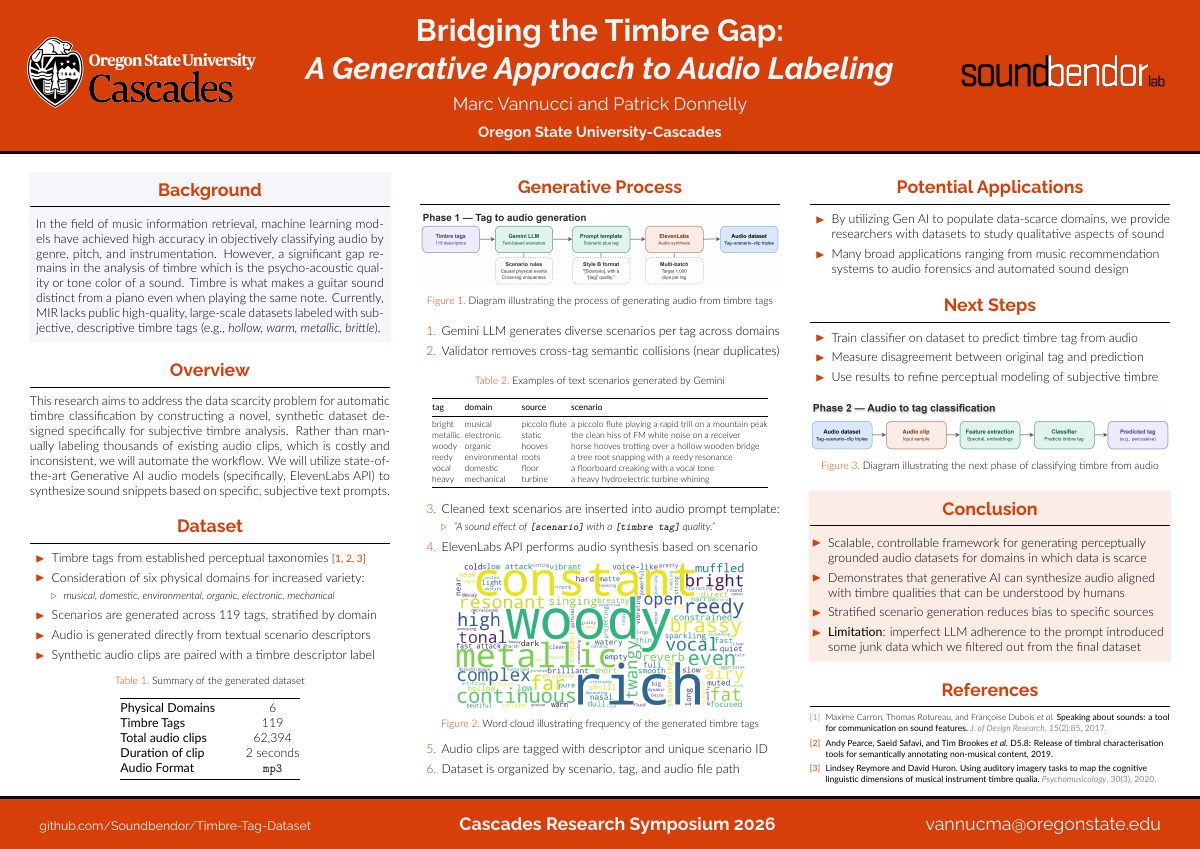
Bridging the Timbre Gap: A Generative Approach to Audio Labeling
Watch and read more
A synthetic dataset for classifying subjective timbre, the tone color that separates a guitar from a piano. Gemini writes varied sound scenarios for descriptive tags such as hollow, warm or metallic, a validator removes near-duplicates, and ElevenLabs generates the audio, avoiding costly and inconsistent manual labeling.
2025

LLM Emotion Prediction
Watch and read more
Can ChatGPT judge how a song feels? GPT-4o-mini rated the valence and arousal of Billboard Top 100 songs since 1958 using three prompt styles: a direct number, five descriptive words and a paragraph. Against four human-annotated datasets, agreement was best with AMG1608, though still only moderate.

Sound Dataset Annotation Tool
Watch and read more
A flexible web framework for crowdsourcing labels for audio datasets. Participants tag sound excerpts with emotional or timbral descriptors in six annotation styles, such as Best Match, Strength and Opposites. Researchers create custom studies, upload sounds and descriptors, track progress and export results for training machine learning models.
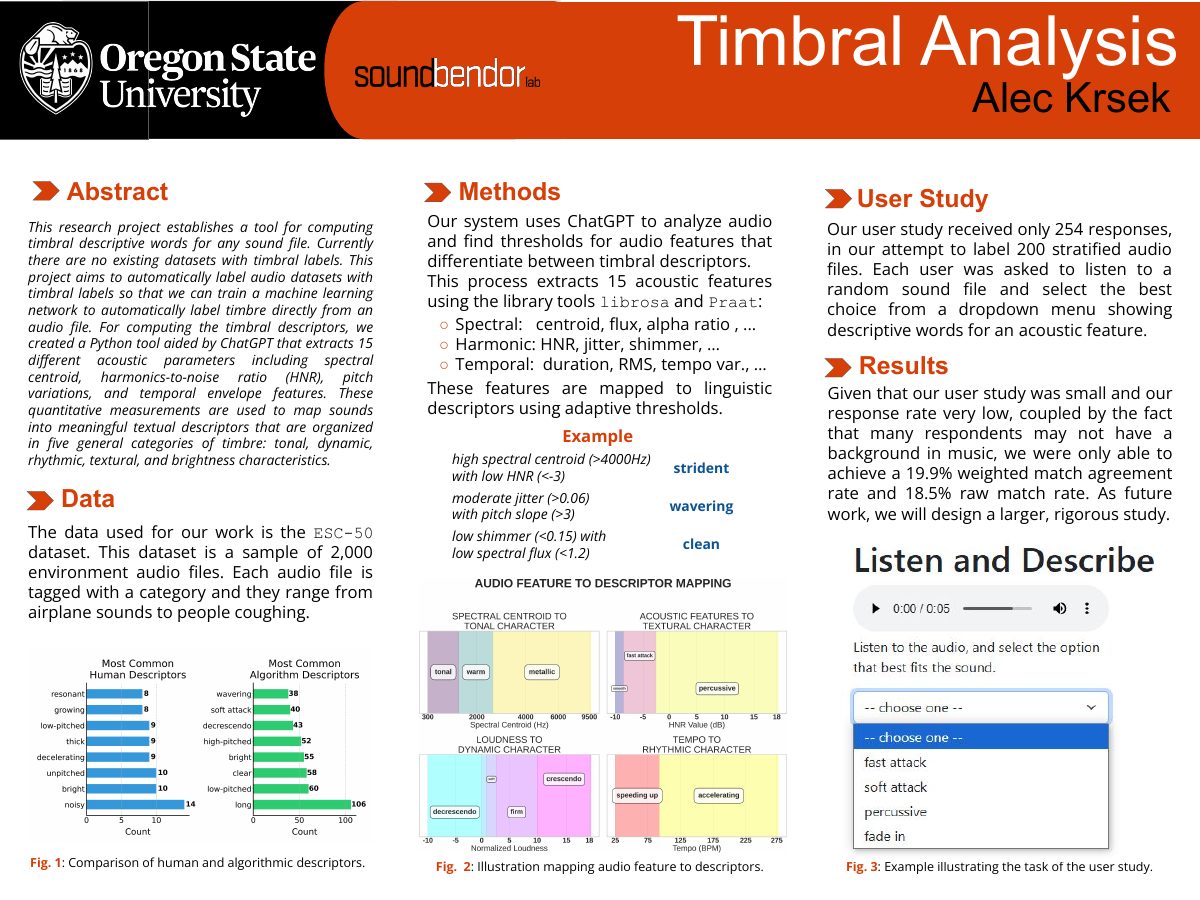
Timbral Analysis
Read more
A Python tool that labels any sound file with timbre words. It extracts 15 acoustic features with librosa and Praat, such as spectral centroid, jitter and shimmer, and maps them to descriptors like strident or wavering. Tested on ESC-50, it aims to label audio datasets automatically.
2024
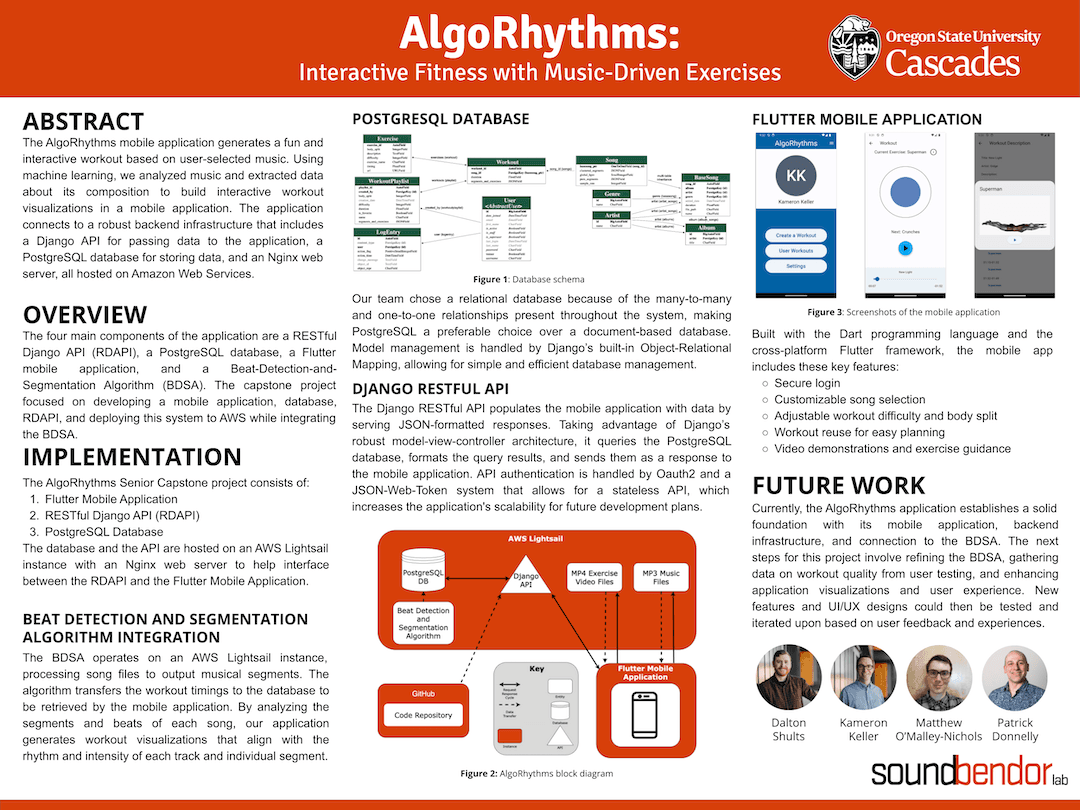
AlgoRhythms
Watch and read more
A mobile app that turns songs you choose into a workout synchronized to the music's rhythm. Machine learning analyzes each song and selects exercises, with descriptions and video guides, so beginners need no prior fitness knowledge. A Django, PostgreSQL and Nginx backend runs on Amazon Web Services.
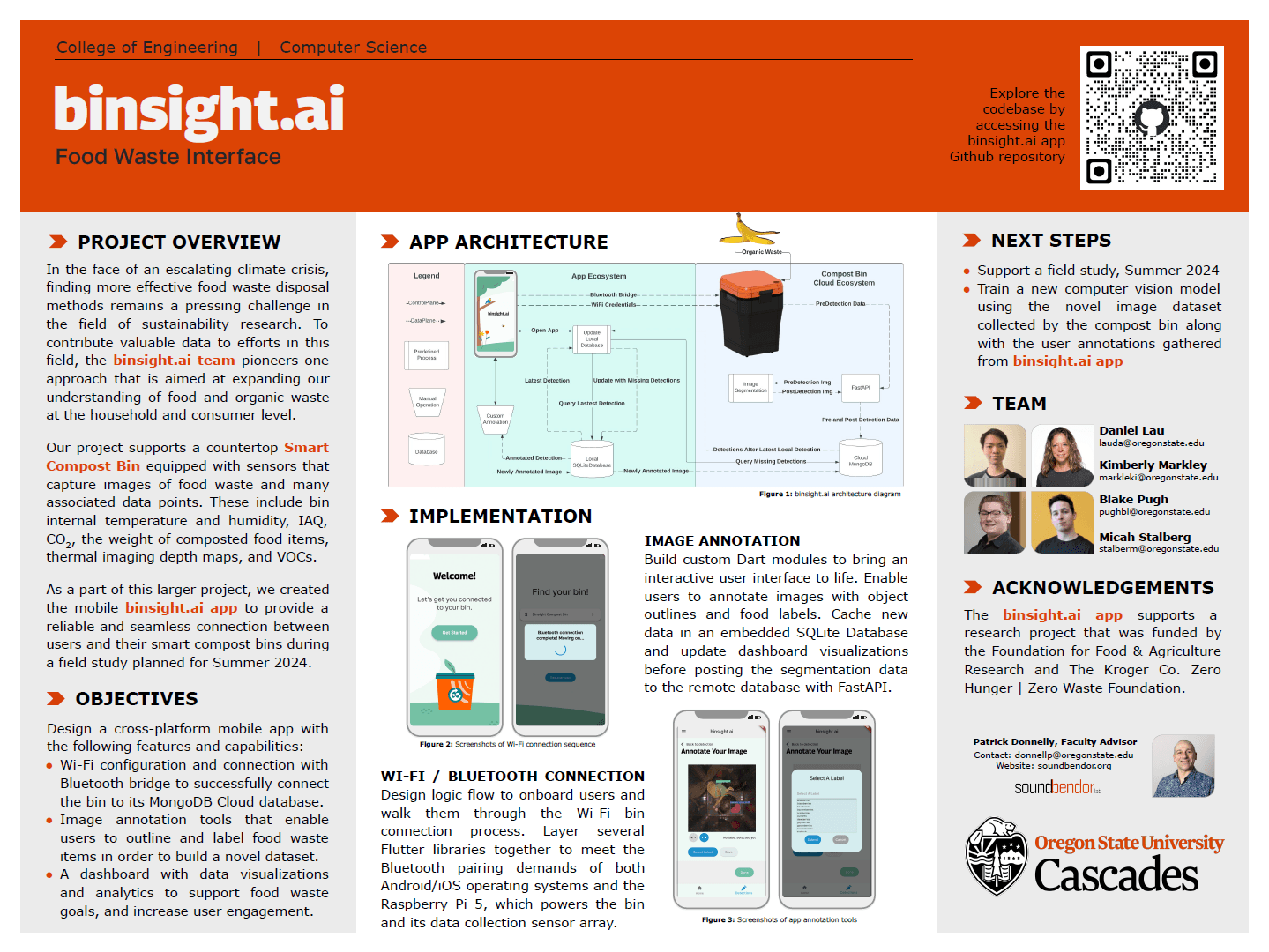
binsight.ai App
Watch and read more
The mobile app for the binsight.ai smart compost bin, built for a 2024 household field study. It connects the bin to Wi-Fi, shows the photos of food waste the bin captures, and charts composted items on a dashboard that encourages waste-reduction goals. Funded by FFAR and Kroger Zero Hunger.
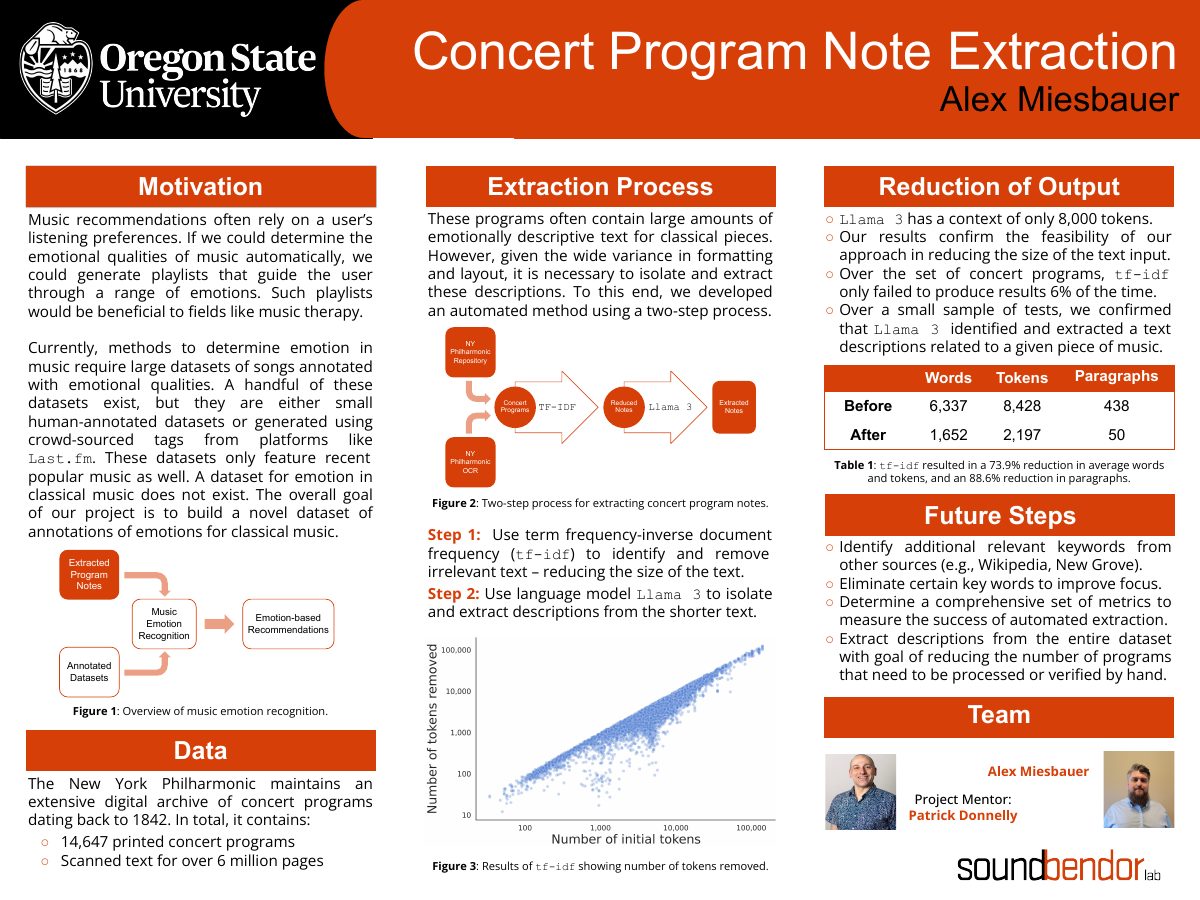
Concert Program Note Extraction
Read more
Pulls descriptions of individual pieces from New York Philharmonic concert programs to build an emotion dataset for classical music. Tf-idf first removes irrelevant text, cutting words by 74%, then Llama 3 isolates the note for a given piece. This work fed into the EmotioNotes dataset.
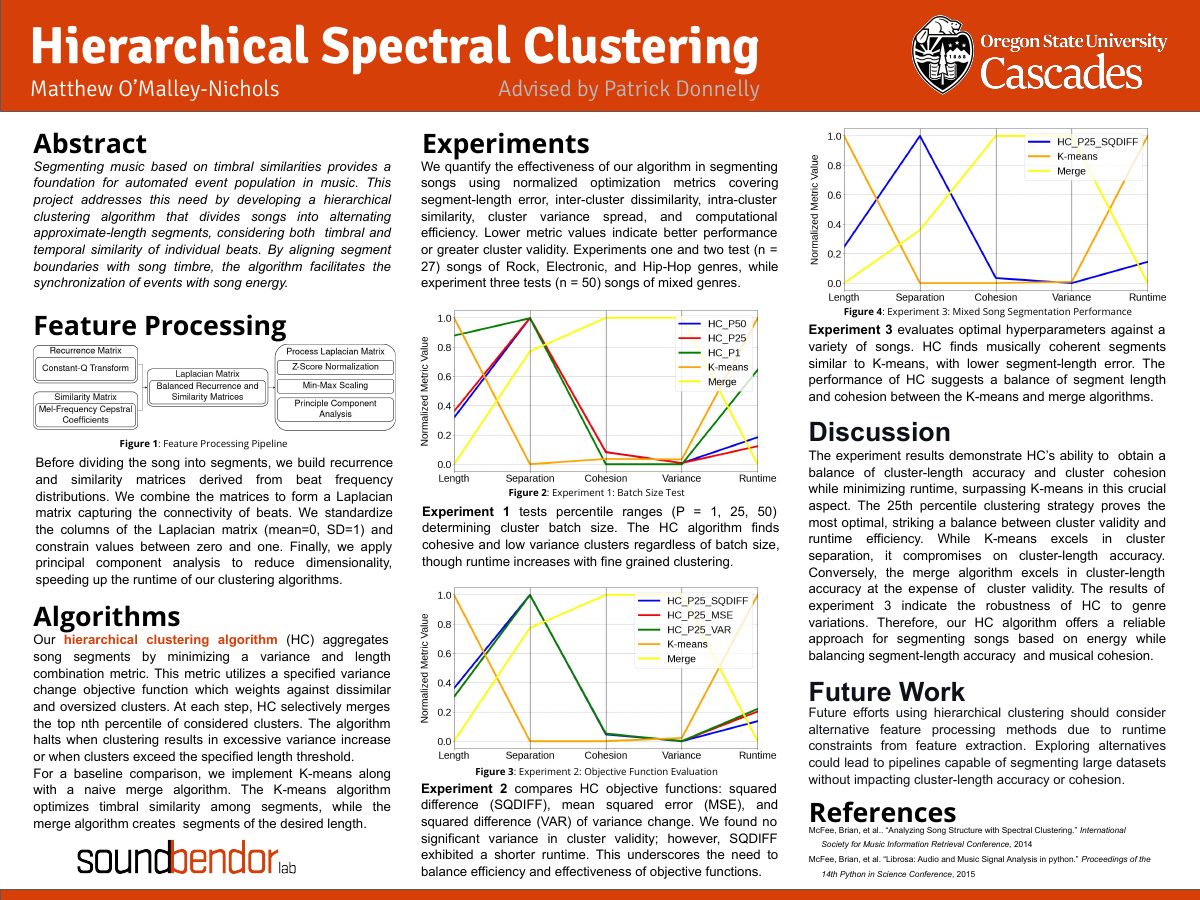
Hierarchical Spectral Clustering
Watch and read more
A hierarchical clustering algorithm that divides songs into segments of similar timbre and approximate length, using recurrence and similarity matrices built from individual beats. Tested on rock, electronic, hip-hop and mixed-genre songs, it balances segment-length accuracy and cohesion better than k-means, helping synchronize events with a song's energy.
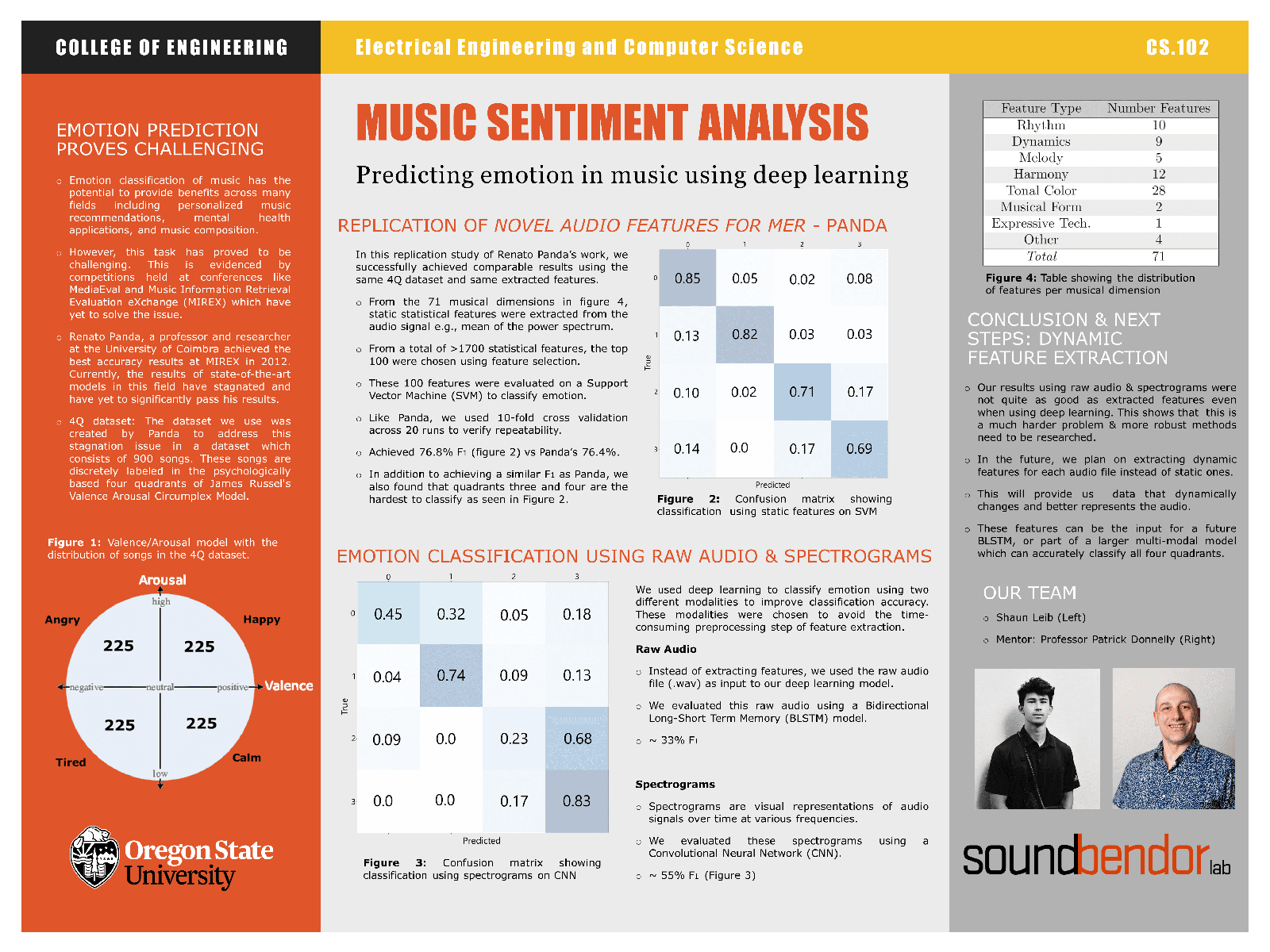
Music Sentiment Analysis
Read more
Predicts music emotion in the valence-arousal space. The project first replicates Renato Panda's support vector machine results on static audio features, then trains a convolutional network on mel-spectrograms and a bidirectional LSTM on raw audio, and compares all three approaches with next steps for improvement.

Sound Annotation Tool
Watch and read more
The first version of the lab's sound annotation website, built over a summer. Volunteers register, listen to music snippets and choose descriptors such as noisy, smooth or bright, drawn from published timbre research. A React front end and an Express and MongoDB API store annotations that researchers export as CSV.
Walking Piano Interface
Watch and read more
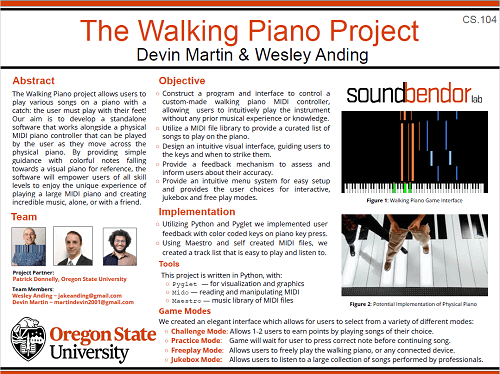
Software for a giant floor piano played with your feet. Working with a physical MIDI piano controller, it guides players with colorful notes falling toward an on-screen keyboard, so people of any skill level can play songs alone or with a friend while walking across the keys.
2023
AlgoRhythms
Watch and read more
Generates exercise workouts from any song. The song is segmented into labeled sections of similar material, each section is mapped to an exercise that fits its rhythm and energy, and a generated video guides the user through the routine with repetition timing that matches the beat.
Chirp
Watch and read more
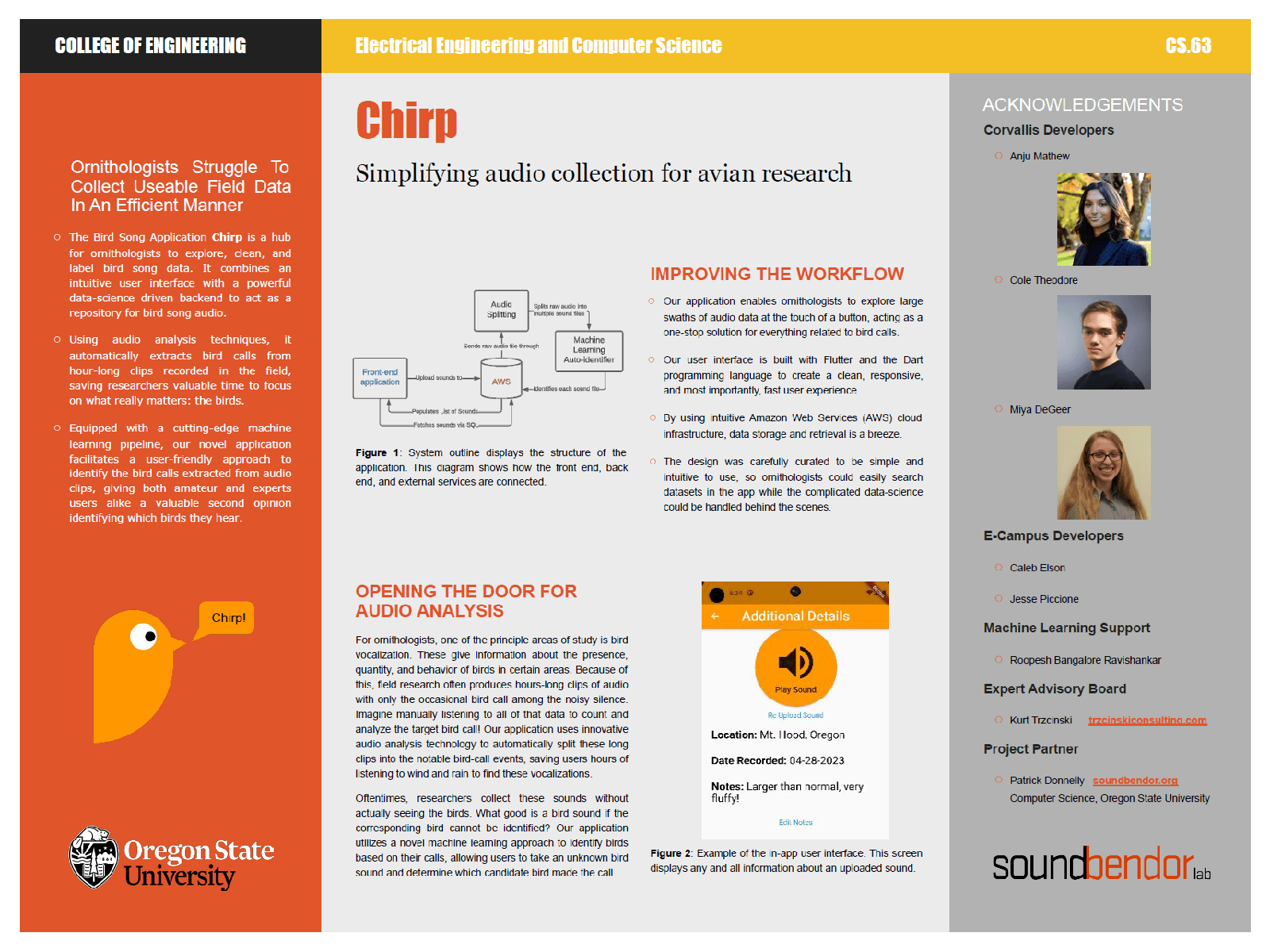
A web hub where ornithologists explore, clean and label bird song recordings. Audio analysis automatically extracts bird calls from hour-long field recordings, and a machine learning pipeline suggests species, giving amateurs and experts a second opinion while saving hours of listening. It also serves as a repository of bird audio.
Concert Program Data
Watch and read more
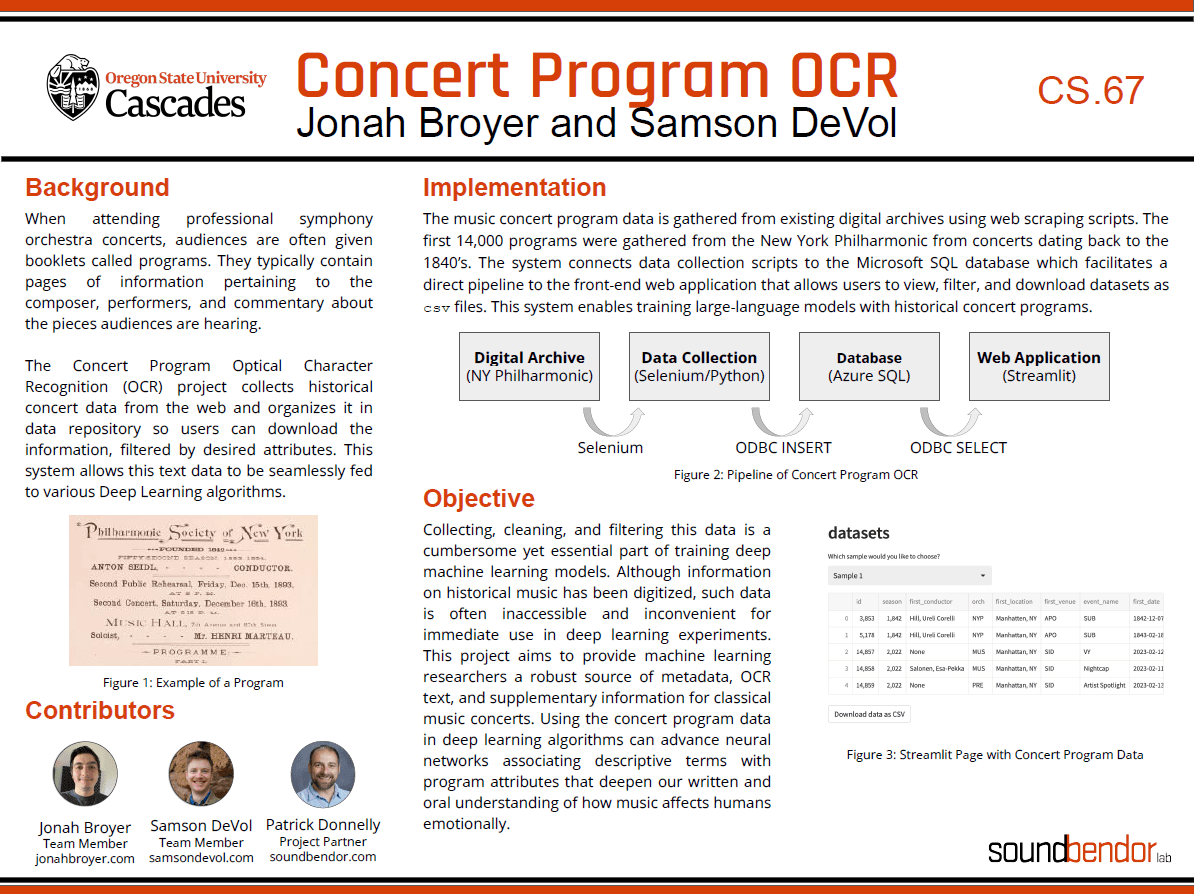
Collects historical concert programs from the web, converts them to text with optical character recognition, and organizes them in a searchable repository. Users can filter by attributes and download the data, which is ready to feed to a range of deep learning algorithms for research on music and text.
Deployable Ensembles for River Forecasting
Watch and read more
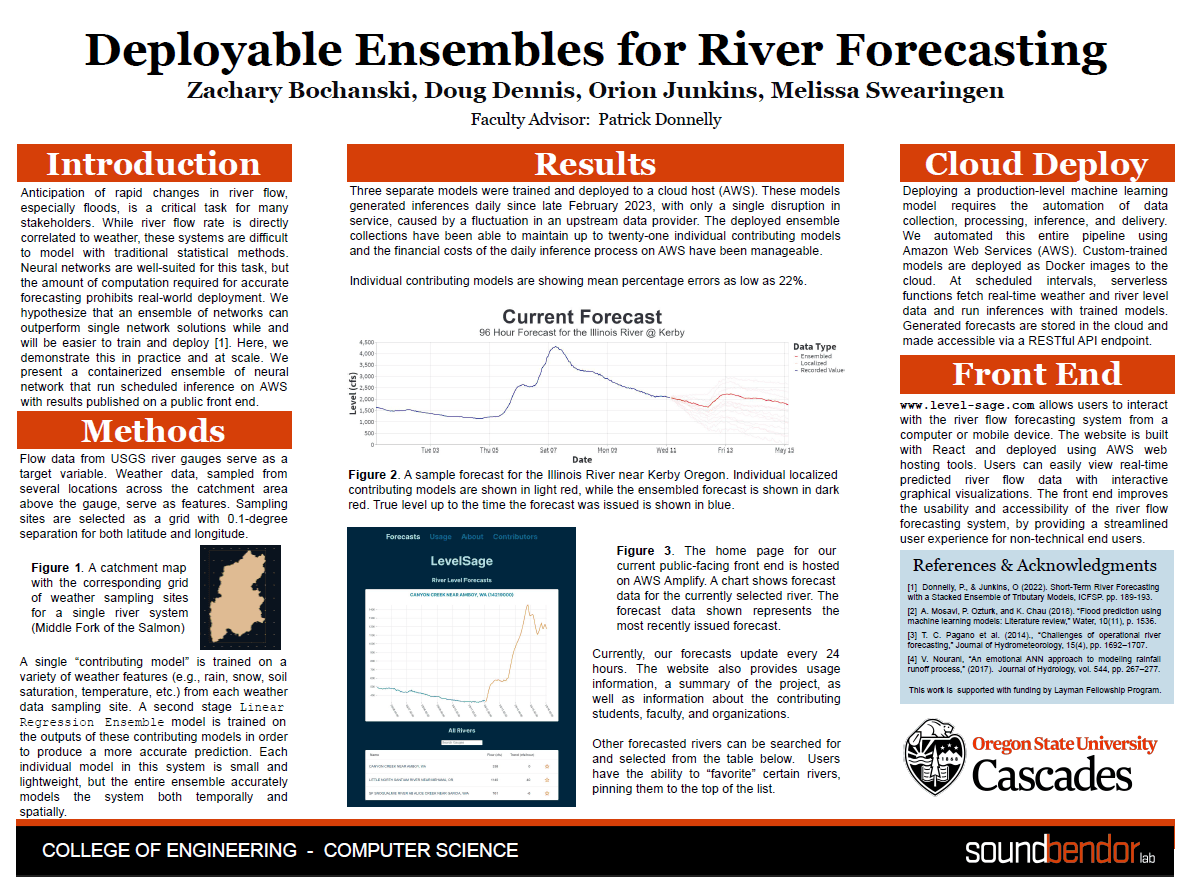
Forecasts rapid changes in river flow, including floods, with an ensemble of small neural networks that is cheaper to train and deploy than one large model. The containerized ensemble runs scheduled inference on Amazon Web Services and publishes its forecasts on a public website, demonstrating the approach at scale.
Hearing Simulator
Watch and read more
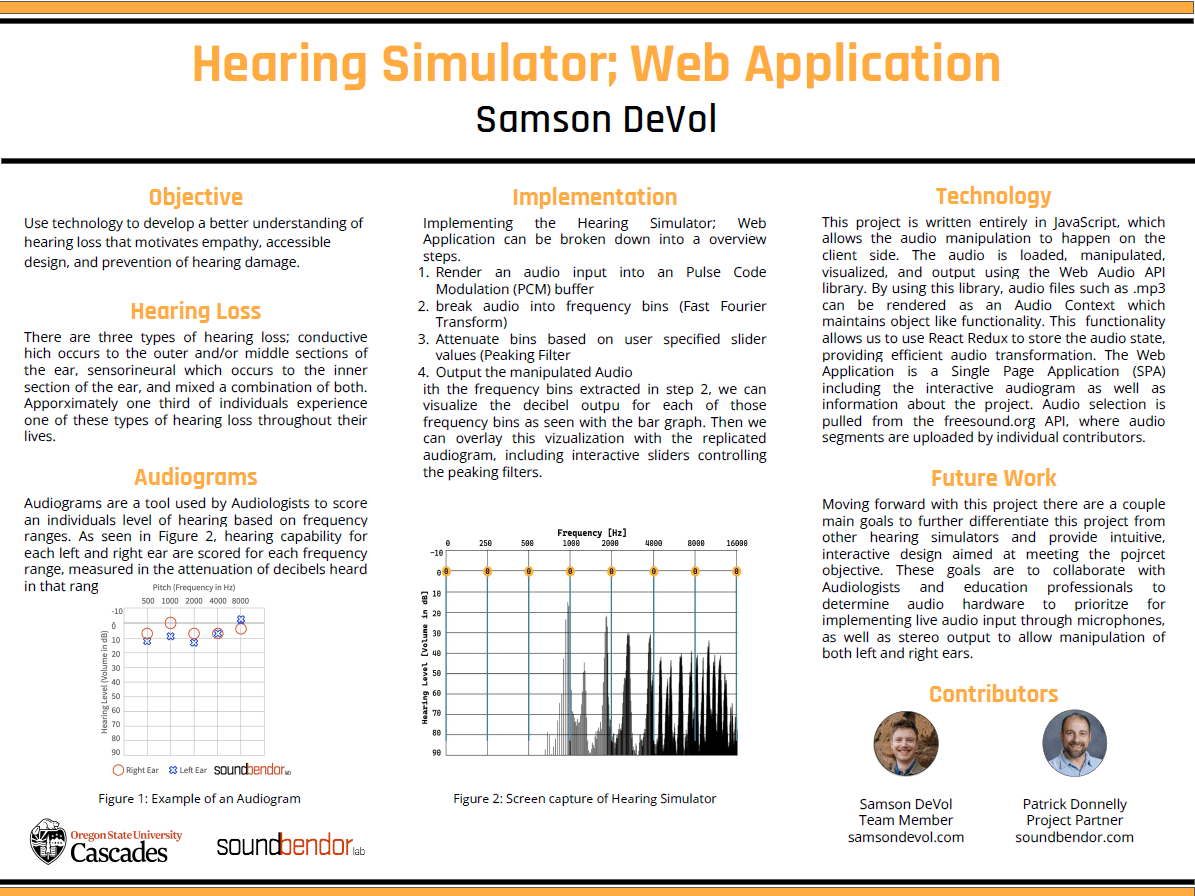
A website that simulates hearing loss. Audio is filtered through an adjustable audiogram, so listeners can hear how different types and degrees of hearing loss change familiar sounds. The goal is to build understanding and empathy, encourage accessible design and promote the prevention of hearing damage.
Made with Love in Bend
Read more
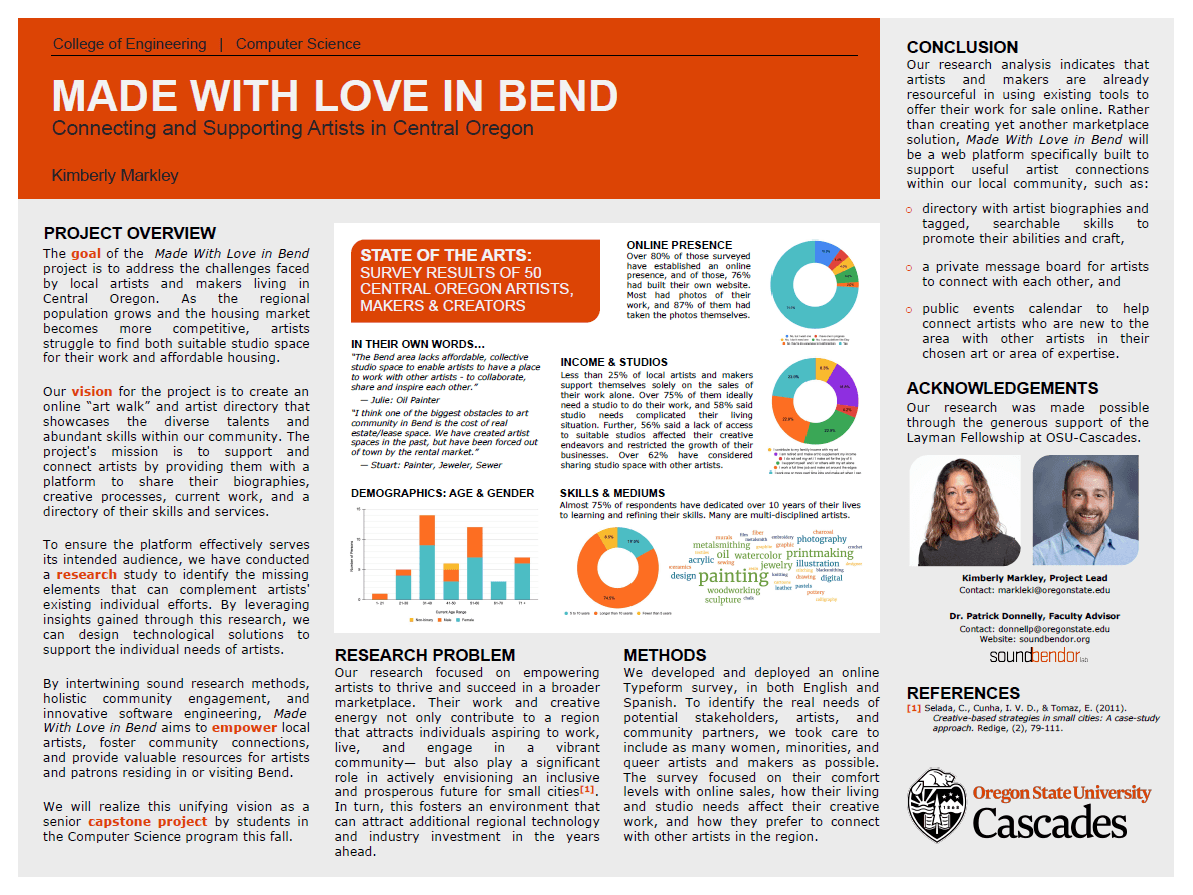
An online art walk and artist directory for Bend, Oregon, where local artists share biographies, creative processes, current work, skills and services. To learn what artists, partners and other stakeholders actually need, the team designed and ran a bilingual survey that will guide the platform's design.
Meal Spotter Website
Watch and read more
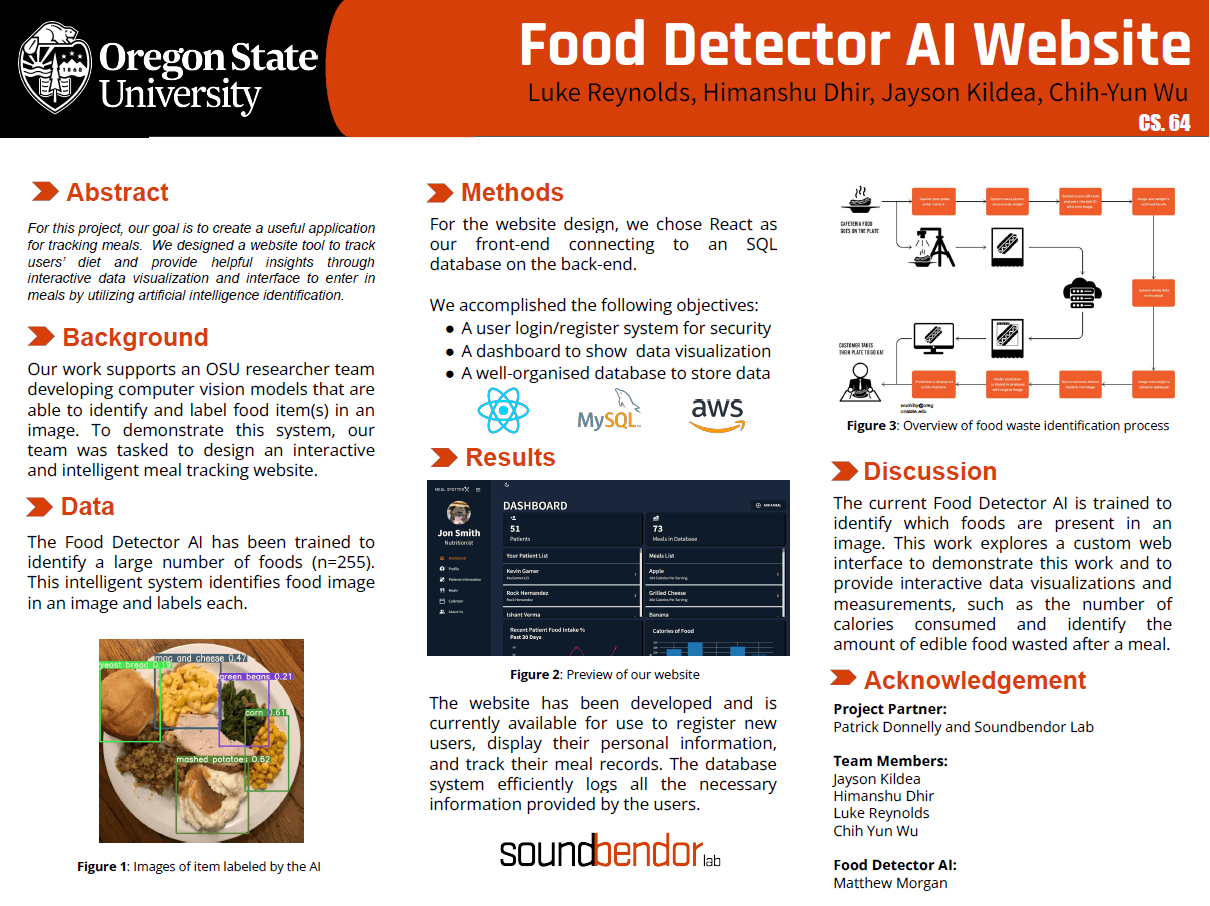
A website for tracking meals and diet. Users enter meals through an interface that uses AI to identify foods, and interactive data visualizations turn the record into helpful insights about their diet and eating habits over time, replacing the work of keeping a written food diary.
MIDI Performance Data
Watch and read more
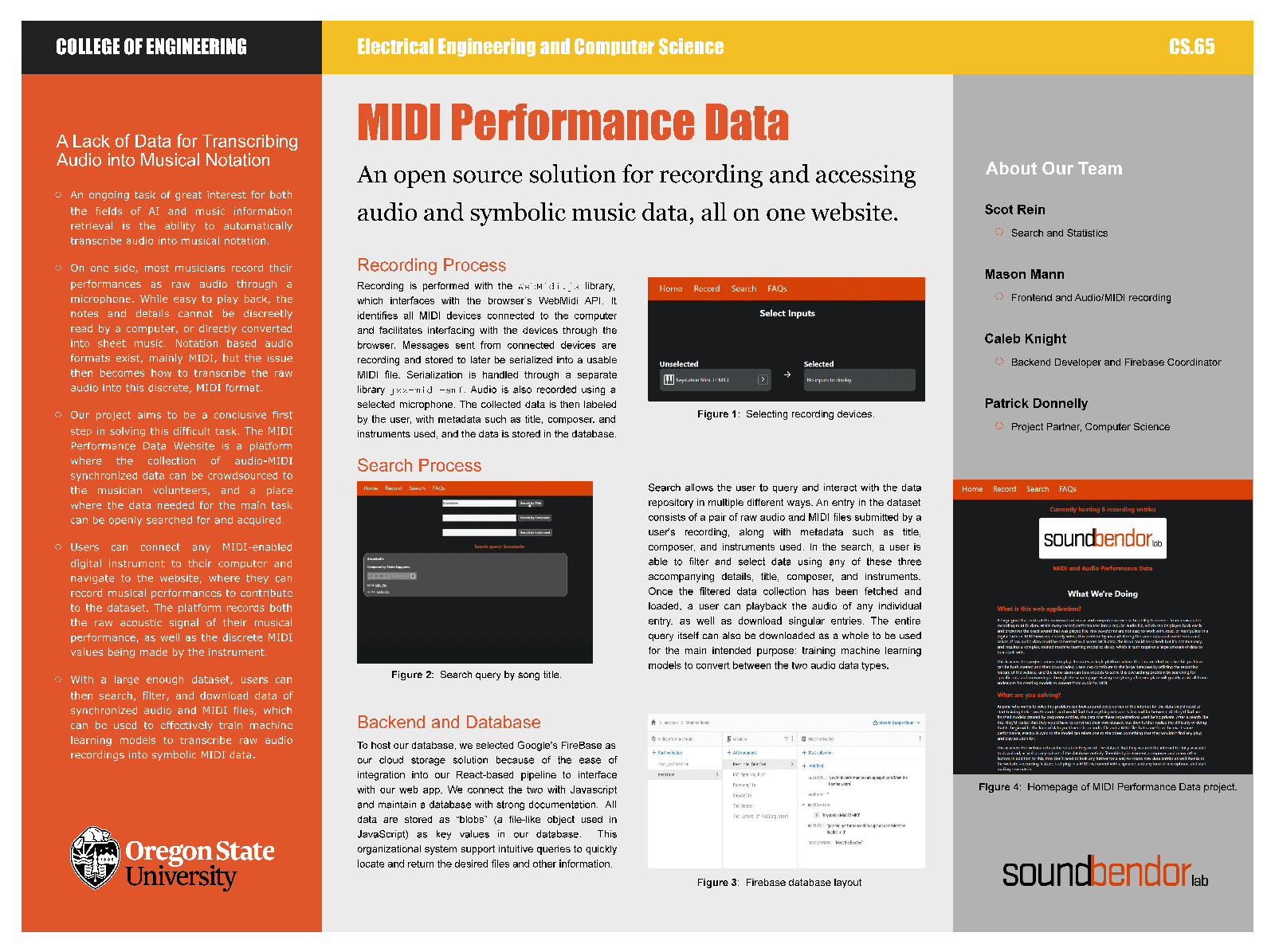
A website that crowdsources synchronized audio and MIDI recordings from musicians around the world, building a dataset for training models that transcribe music scores directly from audio. A public repository lets researchers search, filter and download the paired audio and MIDI files for their own work.
Music Affect App
Watch and read more
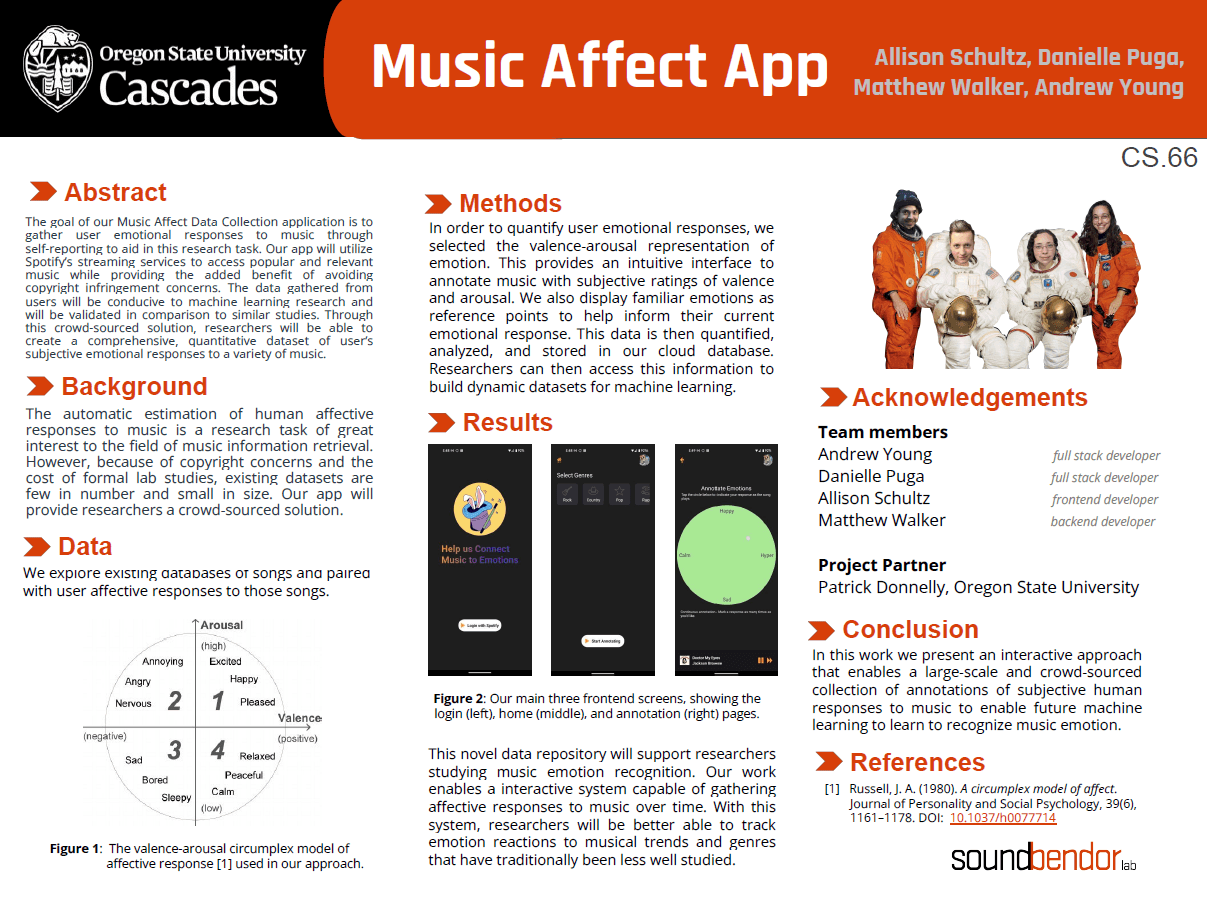
A crowdsourcing app that gathers listeners' self-reported emotional responses to music. Songs stream through Spotify, which avoids copyright concerns and offers popular, current music. The responses form a quantitative dataset of subjective emotion for machine learning research, validated against similar published studies.
Music Affect Data Collection App
Watch and read more
A mobile app that crowdsources emotional responses to music. Users play any song through Spotify and rate how it makes them feel on a valence-arousal scale; anonymized ratings are stored in a cloud database. The data could support mood-based playlists, better recommendations and matching songs to situations.
Music Score Visualization
Watch and read more
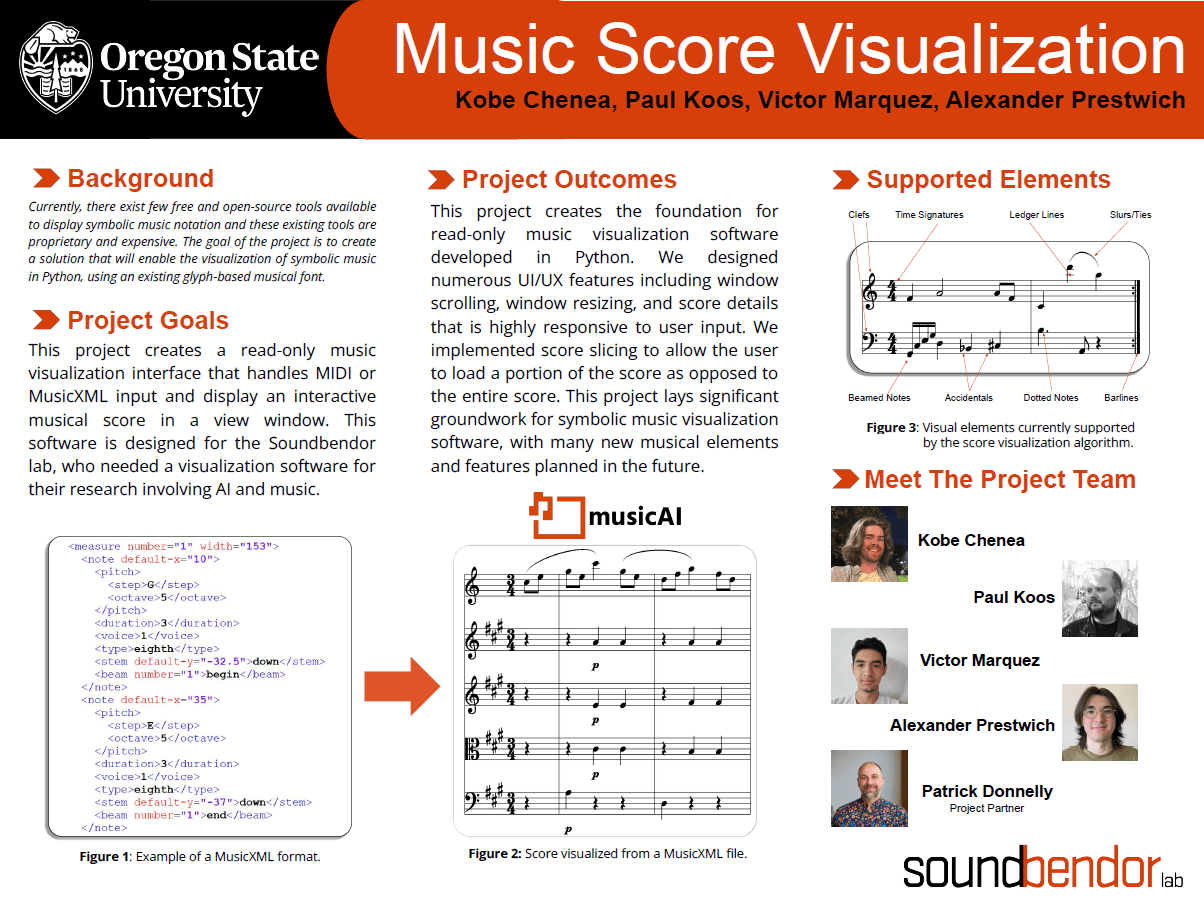
A Python viewer that displays MIDI or MusicXML files as interactive musical scores. Features include responsive scrolling and resizing, detailed score elements and score slicing, which loads only part of a long piece. It lays groundwork for symbolic music visualization software, with more musical elements planned.
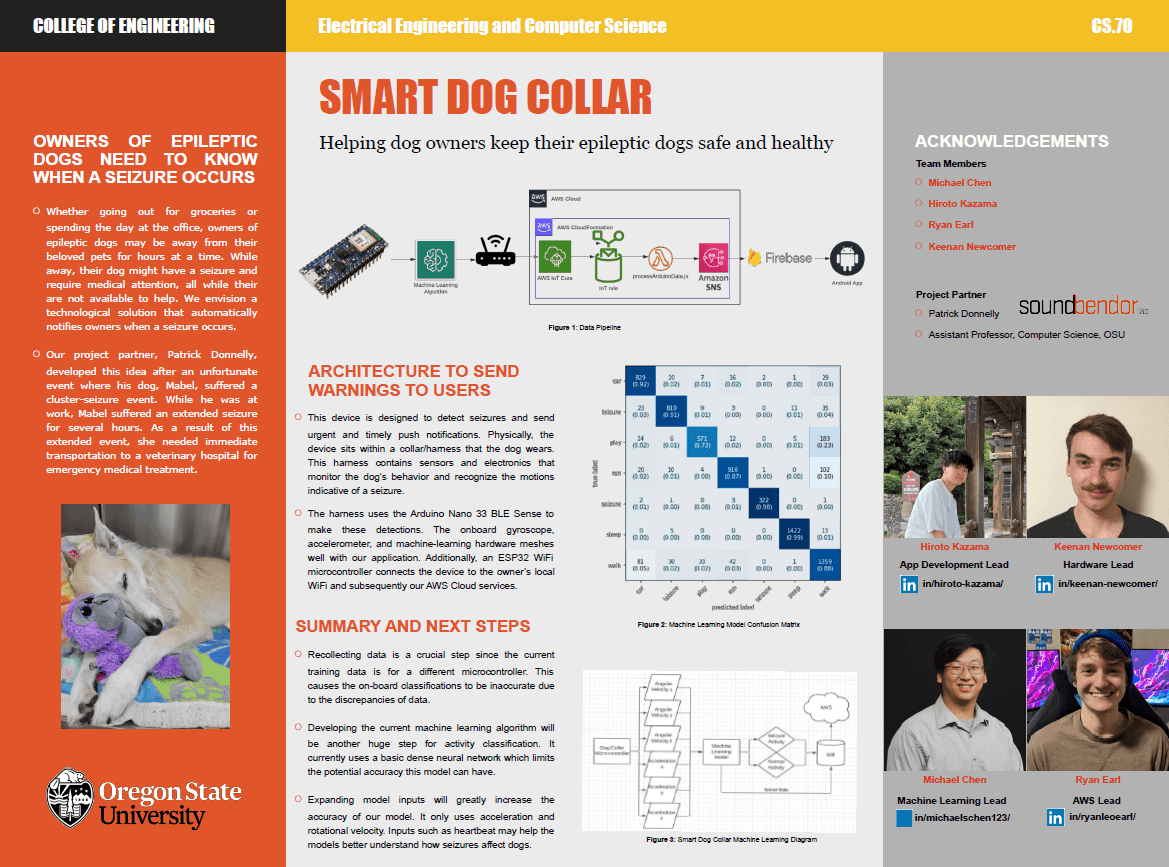
Smart Dog Collar
Watch and read more
A collar and harness that detects epileptic seizures in dogs and sends urgent push notifications to owners. Sensors and electronics in the harness monitor the dog's movement and behavior, and algorithms recognize the motion patterns that signal a seizure, so owners can respond quickly and track episodes.
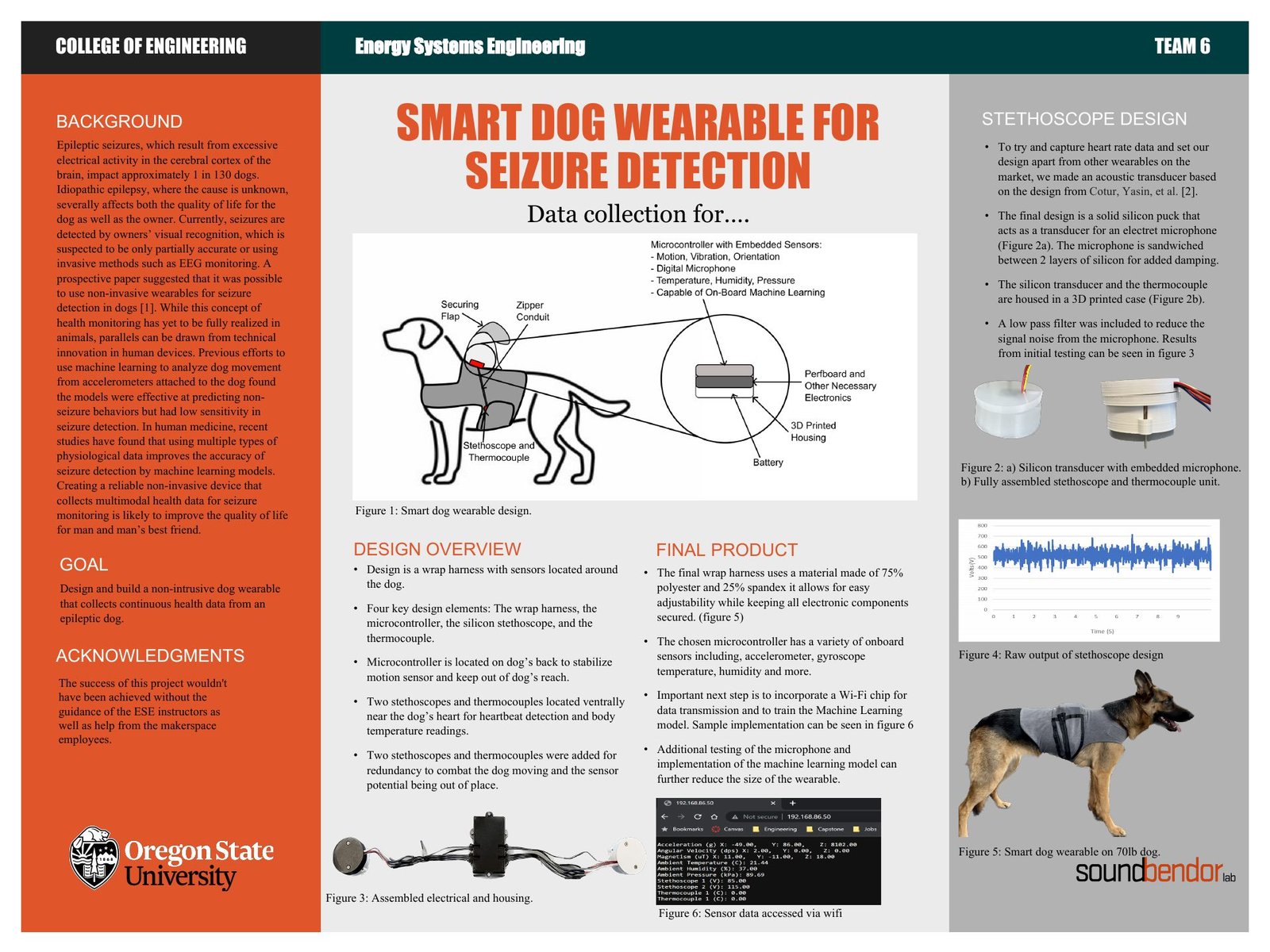
Smart Dog Wearable for Seizure Detection
Read more
The hardware side of the smart dog collar: a comfortable wrap harness that records continuous health data from an epileptic dog. A silicone stethoscope with a microphone and a thermocouple sit near the heart, and a microcontroller on the dog's back adds motion and environmental sensors.
Soundbendor Website Redesign
Watch and read more
A new, flexible and modular website for the Soundbendor Lab, a research group in Oregon State's School of Electrical Engineering and Computer Science. It was designed to meet the needs of a rapidly growing lab and its projects in computational musicology, acoustic analysis and bioacoustics.
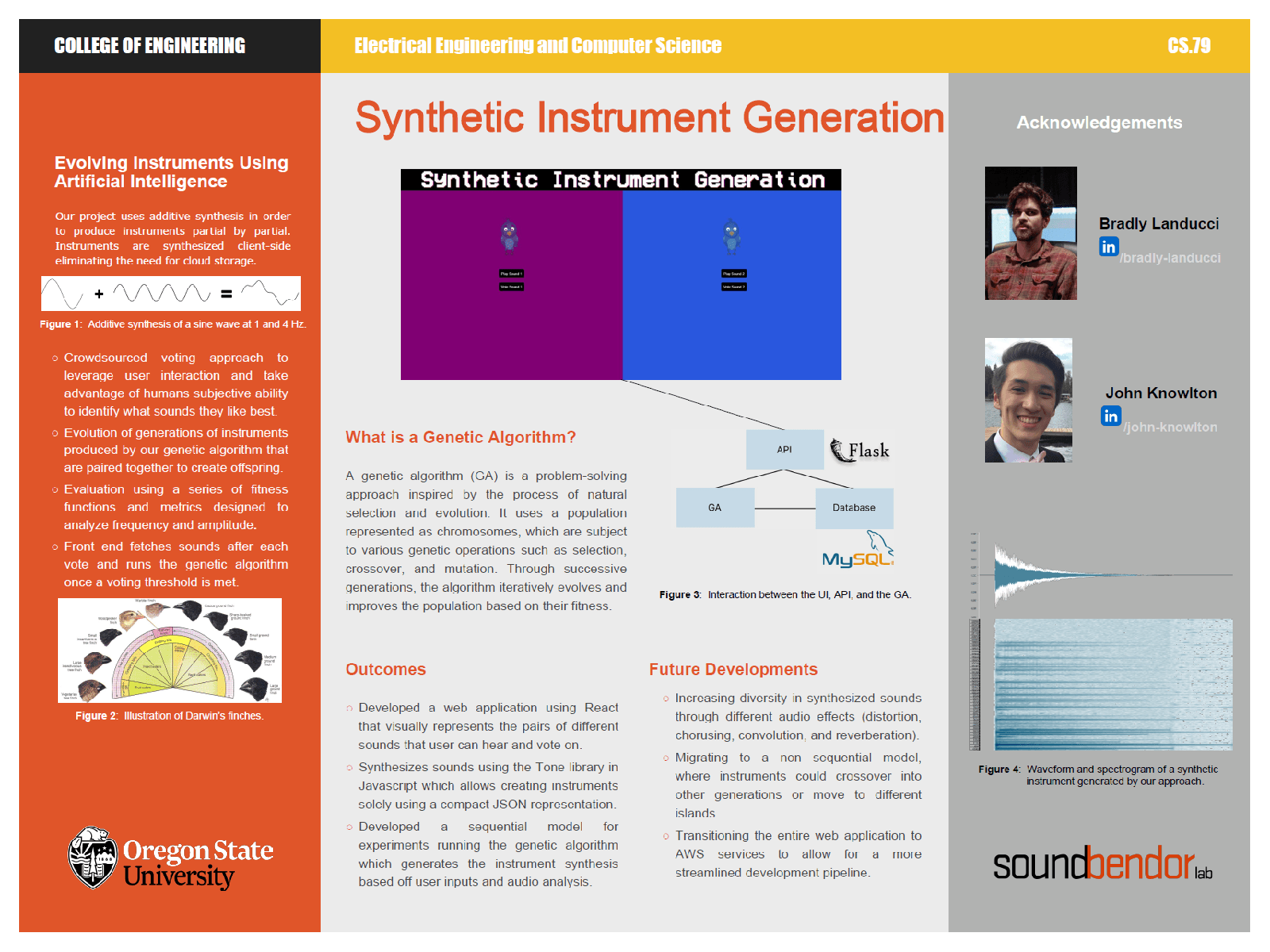
Synthetic Instrument Generation
Read more
A web app that evolves new instrument sounds with a genetic algorithm. Listeners hear pairs of sounds and vote for the more interesting one, providing a crowdsourced fitness function. Instruments are built partial by partial with additive synthesis and rendered in the browser, so no audio storage is needed.
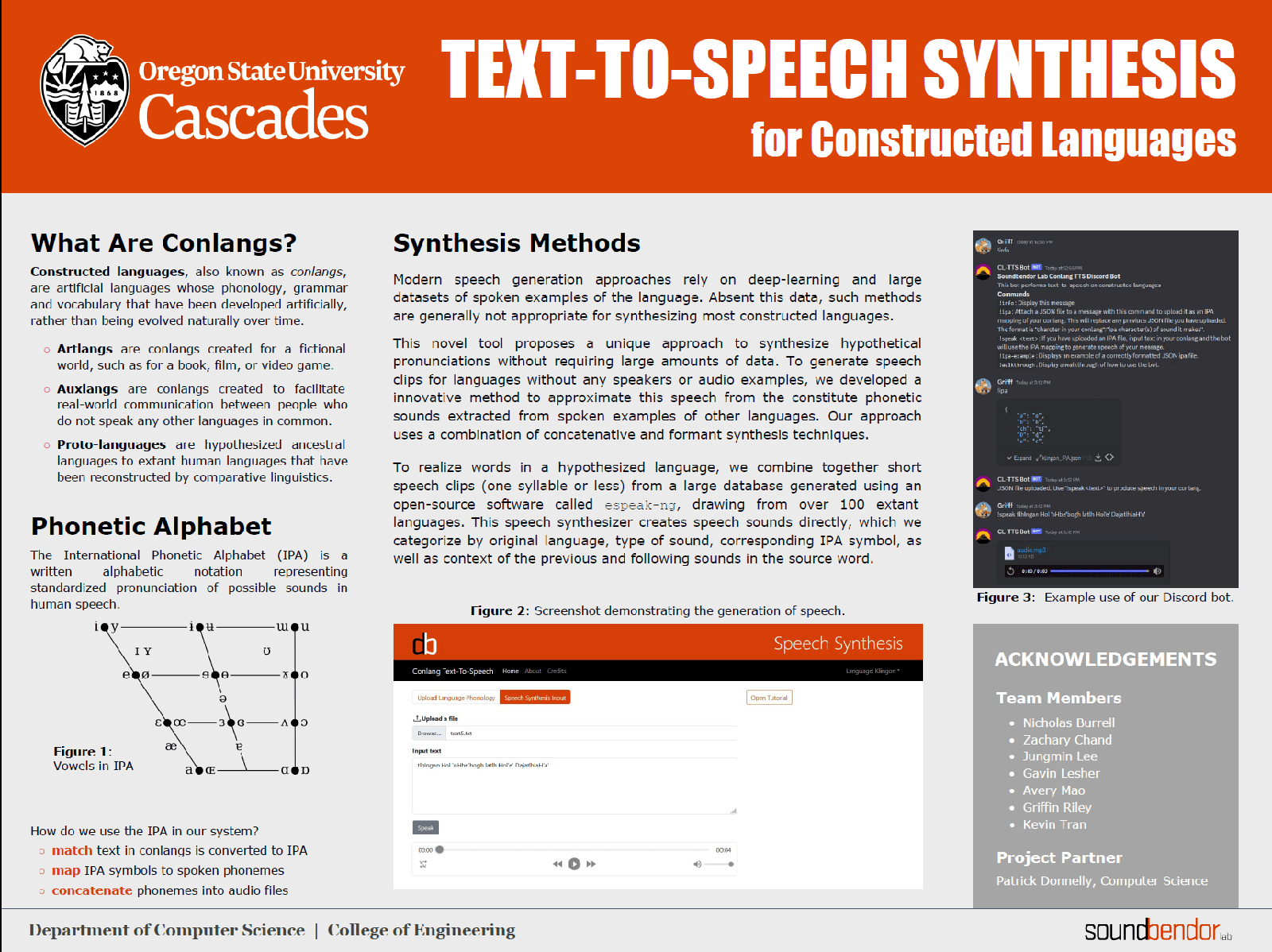
TTS for Constructed Languages
Read more
A text-to-speech tool that voices constructed languages, which have no native speakers or recordings. It assembles hypothetical pronunciations from phonetic sounds extracted from spoken examples of 100 natural languages, combining concatenative and formant synthesis to approximate how an invented language might sound when spoken aloud.
2022
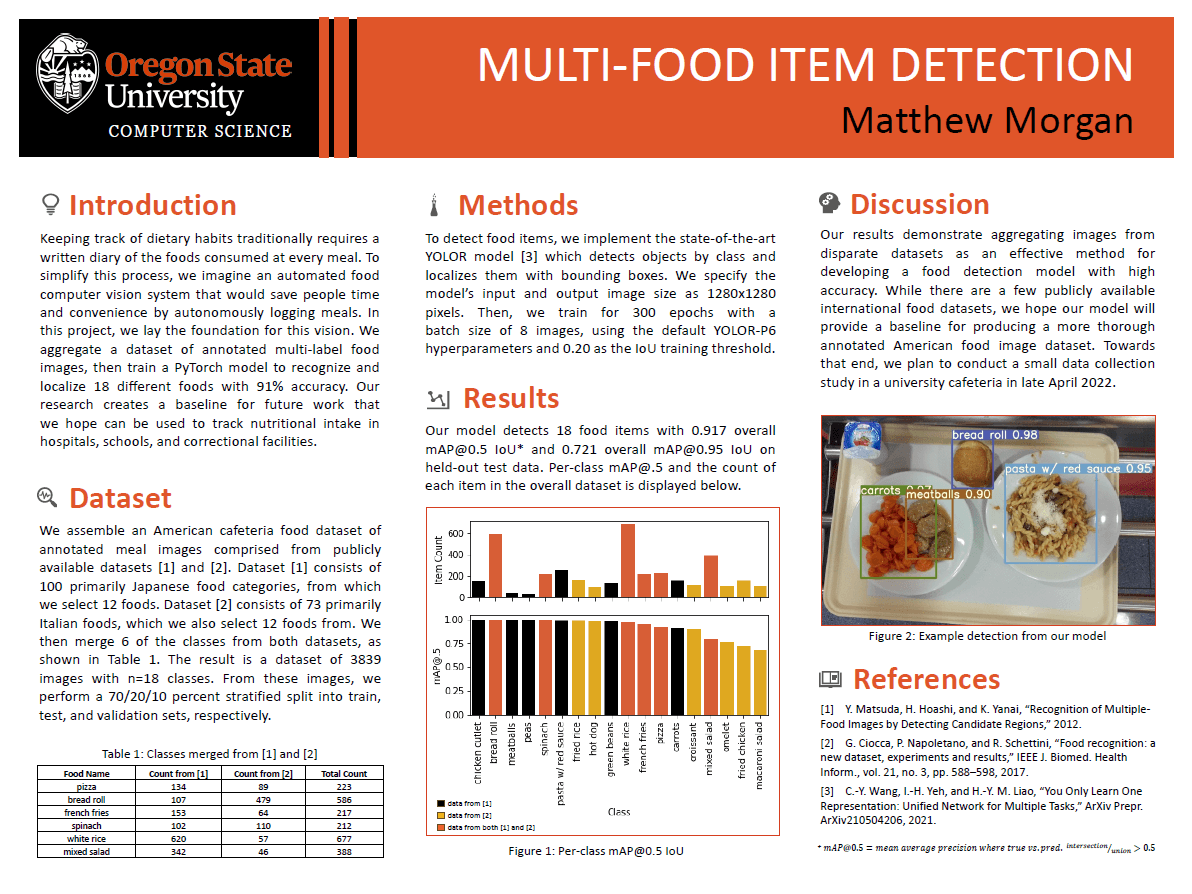
Multi-food Item Detection
Read more
Toward a camera that logs meals automatically instead of a written food diary. The team assembled a dataset of annotated images containing several foods and trained a PyTorch model that recognizes and locates 18 foods with 91% accuracy, a baseline for tracking nutrition in hospitals, schools and correctional facilities.
Multi-Food Items Detection and Localization in Images
Watch and read more
Lays the groundwork for a camera that logs every meal automatically and stores the record in the cloud for nutritionists. The team prepared a machine learning dataset of food images and built a model that recognizes multiple foods in one picture, aiming to help reduce malnutrition in schools and hospitals.
Music Sentiment Analysis
Watch and read more
Trains recurrent neural networks to predict the emotion a piece of music conveys, measured as valence (positivity) and arousal (intensity), directly from raw audio waveforms rather than hand-crafted features. The model learns from a dataset of music excerpts that listeners annotated with emotion ratings.

MusicAI
Watch and read more
A flexible Python toolkit and data representation for loading, storing and manipulating symbolic music notation. It is designed so researchers can evaluate and generate music with artificial intelligence and machine learning algorithms, without first writing their own code to parse and convert score formats.

River Level Forecasting
Watch and read more
Forecasts river flow from weather data across a catchment using an ensemble of recurrent neural networks. A small model is trained for each weather source and their predictions are combined, avoiding high dimensionality. The ensemble's error (MAPE 8.57%) is 10% lower than the best single model.
2021

Conscience Consumer
Watch and read more
A mobile app that helps shoppers buy ethically. It condenses complex information about the practices of the companies behind everyday products into a simple, transparent five-star rating, so consumers can compare brands quickly in the store without researching each manufacturer themselves.
Deep Audio Transcription
Watch and read more
Automatic music transcription, converting audio recordings into the notes that were played, is a hard problem in music information retrieval. This project transcribes directly from raw audio waveforms with a bidirectional LSTM network, producing a time-series MIDI representation of the performance without spectral preprocessing.

Detecting Seizures in Dogs
Watch and read more
Epilepsy affects about one in 130 dogs, and current monitoring is often invasive. This project uses accelerometer and gyroscope sensors to detect and classify movement, capturing seizure episodes non-invasively so veterinarians can track each patient's seizure history and plan better treatment.
Identifying Musical Instruments with Machine Learning
Watch and read more
Identifies musical instruments directly from raw audio, with no spectral analysis or feature extraction. A bidirectional LSTM was trained on one-second, downsampled excerpts from the RWC Music Database, which covers each instrument across its range and dynamics, to classify ten instruments.
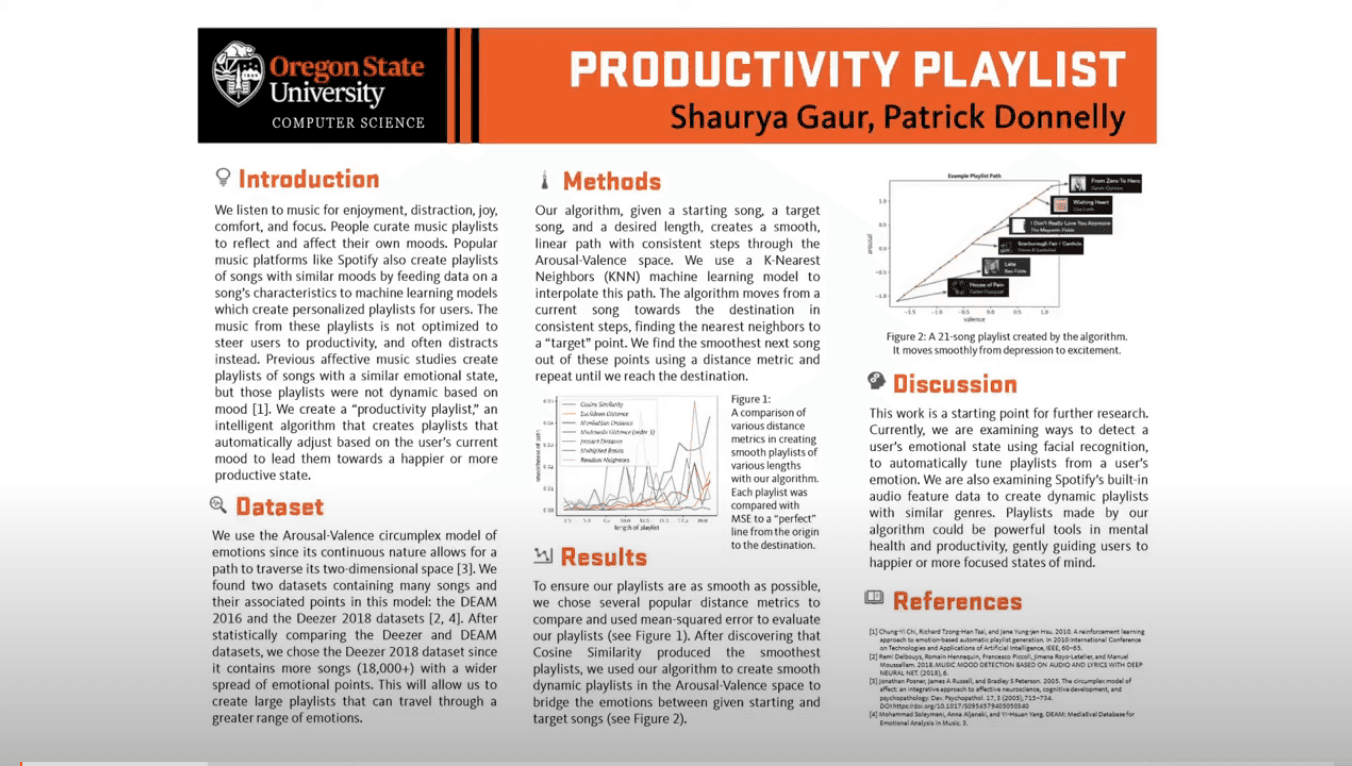
Mood Dynamic Playlists
Watch and read more
Streaming playlists group songs of a similar mood and often distract rather than help. This project builds an intelligent playlist that adjusts to the listener's current mood and gradually steers them toward a happier or more productive state, interpolating a path between emotions from song to song.
Semantic Analysis of Music Discourse
Watch and read more
Predicts the emotion a song conveys from what people say about it on social media. The framework extracts features from user comments by analyzing the sentiment of individual words, offering an alternative to costly listening studies for labeling music emotion at scale.
Voice Vote
Watch and read more
Can a model tell how a crowd voted just by listening? Recordings of single people saying yes or no were mixed into crowds of one to ten simultaneous voices, labeled with the proportion of each answer. BLSTM models trained on raw audio then predicted the crowd's average response.
2020
Audio Transposition
Watch and read more
Uses deep recurrent neural networks to transpose audio, shifting pitch and harmonics to new frequencies in near real time, unlike slow sample-by-sample generators. The network learned encodings of pitch and timbre, and generalized from synthetic monophonic training sounds to real polyphonic music while keeping its tone color.
Automatic Music Transcription
Watch and read more
Converts audio recordings of music into MIDI, a hard problem in music information retrieval that has been attempted with many network types and data formats. This project pairs a bidirectional LSTM network with a time-series MIDI representation to transcribe the notes directly from audio.
Canine Seizure Data Collection Study
Watch and read more
Veterinary specialists need better ways to monitor canine epilepsy to plan treatment. This project surveyed the seizure-monitoring devices already on the market, then designed research protocols and recruitment materials for a study that will monitor seizures in dogs living with epilepsy.
Music Sentiment Analysis
Watch and read more
Uses machine learning to predict the psychological effect of music. Neural networks trained on excerpts annotated with valence and arousal, measures of positivity and intensity, learn the patterns in the audio signal associated with different emotions, shedding light on how people respond to music.
Productivity Playlist
Watch and read more
An intelligent playlist that adjusts the music it plays according to measurements of the listener's attention and productivity. Unlike earlier affective playlists, which keep songs at a similar emotional state, its algorithm takes listeners on an emotional journey toward focus and productivity.
Simulating Deafness
Watch and read more
A web app that lets listeners hear how partial hearing loss changes familiar sounds. Audio is filtered according to a pure-tone audiogram, the standard clinical chart of hearing, using peaking filters that reproduce several common patterns of loss, to build understanding of how others perceive the world.
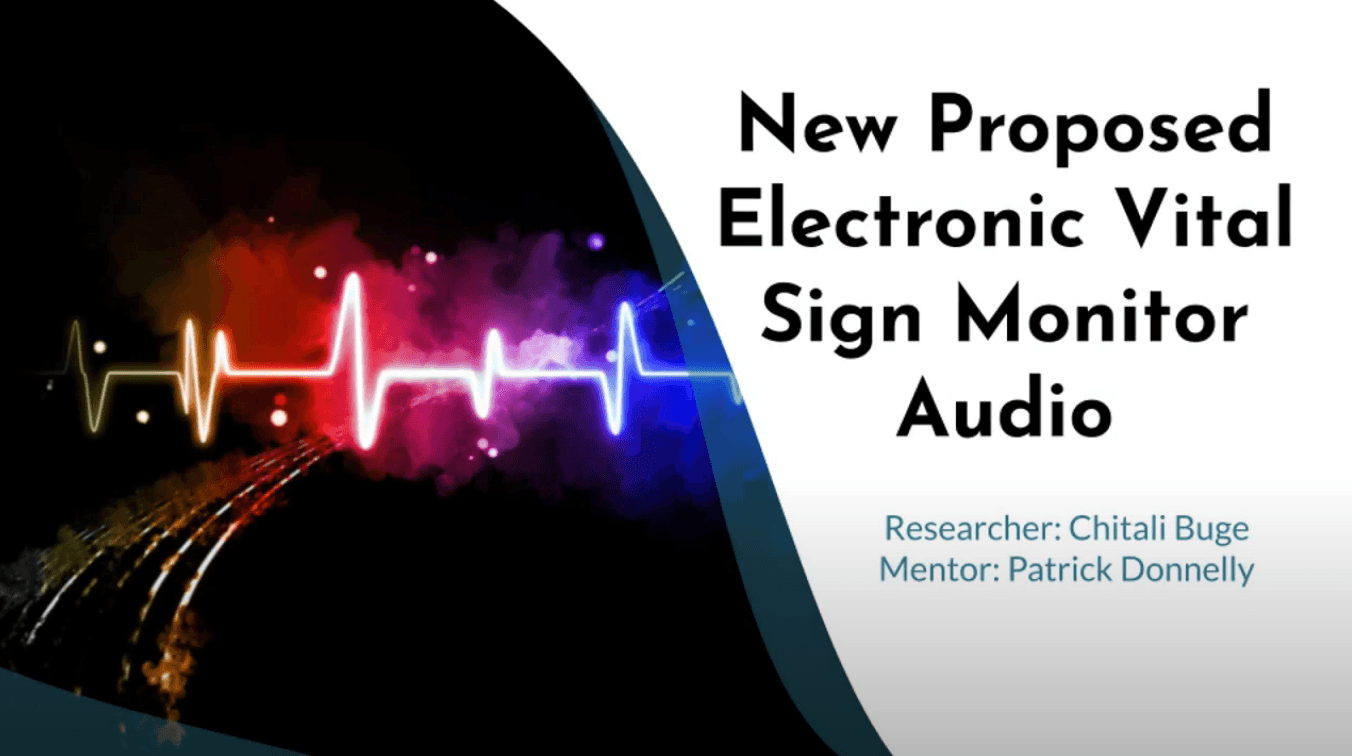
Sonifying Vital Sign Monitor Audio
Watch and read more
Hospital vital-sign monitors sound only heart rate, as rhythm, and blood pressure, as pitch. Adding a third measure, blood oxygen level, by changing the timbre of the alert sound would let clinicians hear more of a patient's condition without looking at the screen.
Programs
- Capstone
- EECS senior capstone: year-long team projects that build tools, apps and datasets for the lab. EECS Capstone
- CRF
- Cascades Research Fellowship: a mentored research fellowship for OSU-Cascades students in Bend. CRF
- URSA
- URSA Engage: a mentored first research experience for early undergraduates. URSA Engage
- NCUR
- Presentations at the National Conference on Undergraduate Research. NCUR
- Ind. Study
- Independent study: one-on-one research for course credit.
- Grant
- Student work supported by one of the lab's grants or contracts. Funding